
Every week, we get inquiries that start the same way — someone has a workstation where manual handling is slowing production, or a line that needs to move parts more efficiently between stations, and they have seen KBK crane systems mentioned in specifications or plant layouts. The next question is always about what KBK systems actually handle in practice and how the costs of different configurations stack up.
Where KBK Crane Systems Work Best
KBK crane systems earn their place in facilities where lifting is light but frequent, and where positioning accuracy matters more than raw lifting speed. The most common applications are workstation loading and unloading, assembly-line transport, and process-area handling, where a fixed overhead crane would be overkill and a forklift cannot reach.
CNC machine shops are a textbook application. An operator loading a 200 kg steel billet into a vertical machining center needs a crane that fits the machine envelope, positions the load precisely, and does not tire the operator over a full shift. A KBK workstation crane with a 500 kg or 1000 kg hoist covers most CNC loading tasks, keeps the floor clear for coolant and chips, and pays for itself in reduced manual handling time and injury risk.
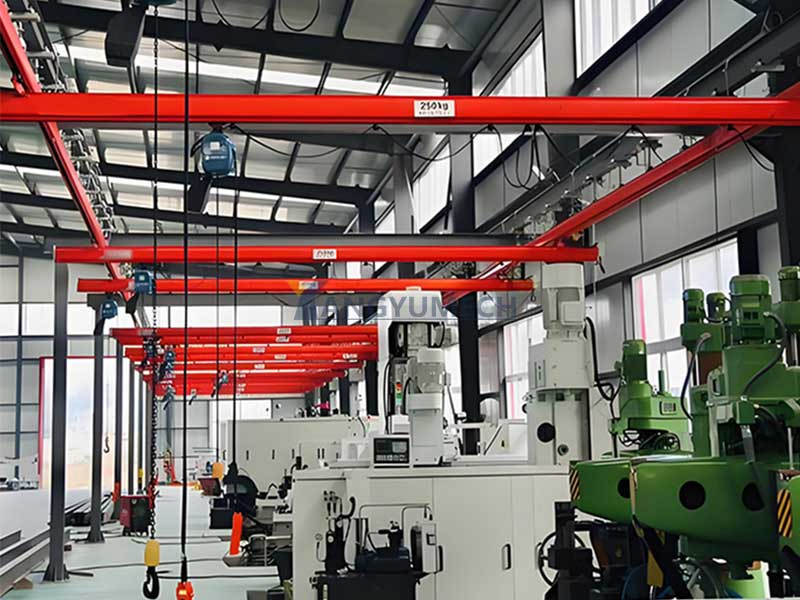
Automotive final assembly lines use KBK suspension systems to move doors, hoods, tailgates, and seats from station to station. The repeatability of the KBK trolley and the smooth variable-frequency hoist control let operators place trimmed panels without adjustment or rework from crane contact damage. A line that runs 60 units per hour with 20-second placements needs a crane that performs consistently shift after shift.
Electronics and appliance manufacturing handle lighter loads — 50 kg to 200 kg —, but the positioning requirement is just as demanding. KBK systems with aluminum enclosed track reduce the push force to near-zero, so an operator can glide a component carrier along the monorail and dock at the next station without wrestling the trolley. Cleanroom-rated KBK systems with stainless track and food-industry lubricants handle semiconductor assembly, pharmaceutical packaging, and medical device manufacturing.
Maintenance and repair workshops use freestanding KBK workstation cranes to cover individual service bays. A freestanding column-supported system lets the workshop put a crane over an engine stand, a press, or a workbench without modifying the building structure. When the workshop layout changes, the freestanding columns move with a forklift.
KBK System Types and How Costs Compare
The four main KBK configurations — suspension runways, monorail systems, workstation cranes, and articulating jib extensions — each have a different cost structure driven by the complexity of the track work and the capacity of the hoist.
Suspension KBK runways are the most economical per meter of coverage. The runway hangs from hanger rods to the building structure, which means the only floor investment is clear floor space. A standard steel suspension runway with a 1000 kg hoist and motorized trolley covers a 6-meter span for a fraction of the cost of a freestanding gantry. The cost drivers are runway span, hoist capacity, and motorized versus manual traverse. A 1000 kg motorized suspension system over a 10-meter span typically costs significantly less than a comparable freestanding workstation crane because there are no columns, foundations, or floor anchors to install.
KBK monorail systems cost more than a straight suspension runway of the same length because the curves, switches, and turntables that route the monorail around obstacles add both material and engineering complexity. A simple, straight monorail with no curves is priced comparably to a suspension runway. Add two 90-degree curves and a transfer switch, and the material cost climbs noticeably. The benefit is that the monorail follows the production flow rather than requiring the production flow to work around the crane — in automotive final assembly and white goods manufacturing, that flexibility often justifies the additional cost.
Freestanding workstation cranes eliminate the dependency on building structure but add columns, base plates, and floor anchors. The floor must be rated for the column reactions, which can be a constraint in older buildings with thin concrete slabs. The advantage is complete positioning flexibility — the crane covers whatever area you define, and you can relocate it by moving the columns. A freestanding workstation crane covering the same 6-meter span as a suspension runway costs more upfront due to the columns and floor work, but the ability to reposition the crane is valuable in shops that change their layout frequently.
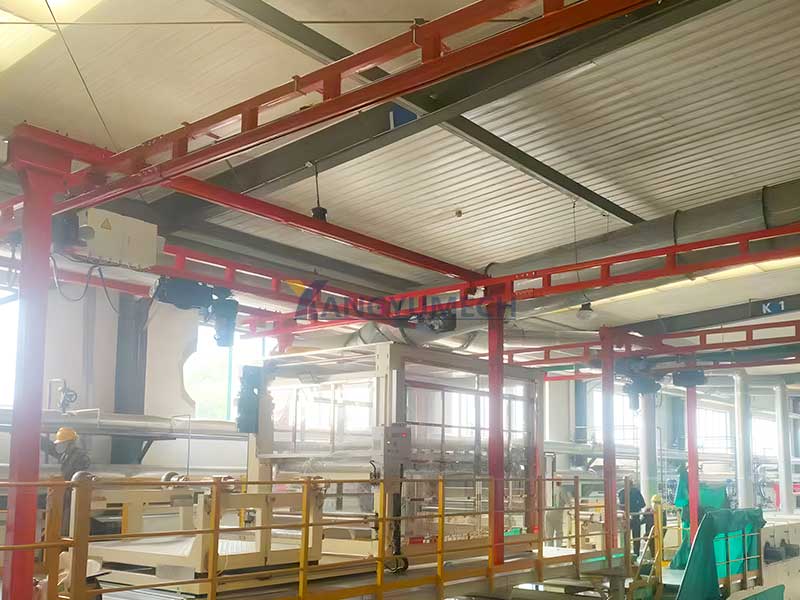
Articulating jib extensions attach to the end of any KBK runway and extend reach into machine openings or around obstacles. The cost of an extension depends on the reach length and whether it is manually or motorized operated. Adding a 2-meter motorized articulating extension to an existing suspension runway is typically far less expensive than modifying the runway itself to reach the same point.
Hoist capacity drives cost across all configurations. A 250 kg hoist costs less than a 2000 kg hoist, and a manual trolley costs less than a motorized trolley. Upgrading from a manual chain hoist to a motorized wire rope hoist adds meaningful cost but transforms the user experience in high-cycle applications. The practical approach is to specify the minimum capacity that covers the heaviest load safely — over-specifying adds cost without proportional benefit.
Yangyumech KBK Crane Systems
Yangyumech manufactures KBK-style modular crane systems in all four configurations — suspension runways, monorail systems, workstation cranes, and articulating jib extensions — with capacities from 125 kg to 5000 kg. We supply standard systems from stock and engineer custom configurations for project requirements.
Our pricing reflects direct factory margins without distributor markup. We provide itemized quotations that break down runway, trolley, hoist, and installation materials separately, so you understand exactly what drives the cost. For projects with defined budgets, we work with the target specification to identify the most cost-effective configuration.