
If you have looked at hoist specifications from different suppliers, you have probably noticed two distinct design approaches. Some hoists follow the European FEM standard with modular construction, low headroom, and single-layer rope drum design. Others follow the traditional CD and MD type design that has been the workhorse of industrial plants for decades. Both lift loads. The differences show up in how they lift, how long they last, how much headroom they need, and which industries get the most value from each design.
What Defines a European-Style Hoist?
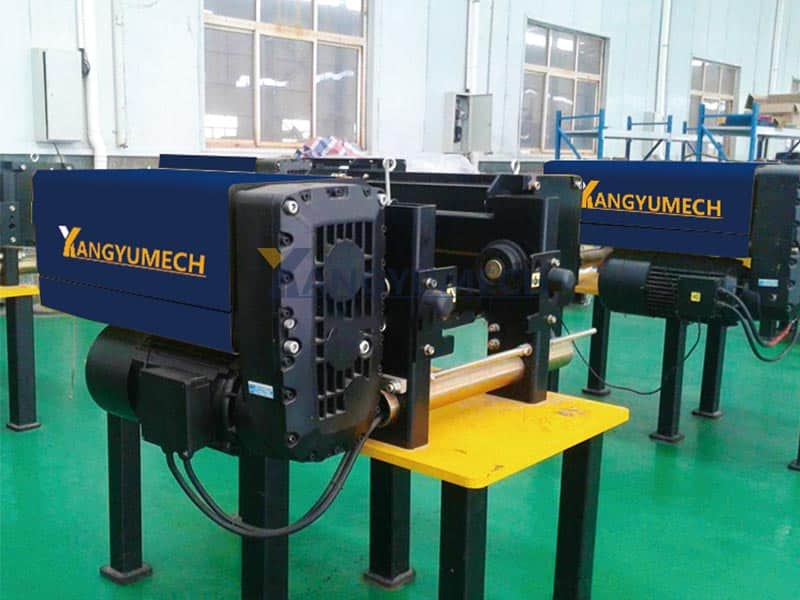
European-style hoists are built to FEM 1Am through 5m duty classifications, with modular components that can be serviced or replaced without dismantling the entire hoist. The rope drum is typically sized so the wire rope wraps in a single layer at full lift height, which extends rope life and keeps the rope fleet angle within safe limits. The hoist body is compact along the runway direction, which reduces the approach dimensions on both ends of the crane bridge and gives the operator better coverage of the work area.
The gearbox in a European-style hoist uses hardened and ground gears with a service life calculated to the FEM duty cycle. The motor is typically a conical rotor brake motor or a separate brake and motor configured for the duty rating. Variable frequency drive on the hoist motion is standard on most European-style hoists, giving the operator precise control over acceleration, deceleration, and final positioning.
Low headroom is a defining feature. The rope drum and gearbox are arranged so the hoist body sits close to the runway beam, maximizing the distance between the hook and the beam. For facilities with limited building height, this extra lift height can be the difference between fitting the crane and having to modify the building structure.
What Defines a Traditional CD or MD Hoist?
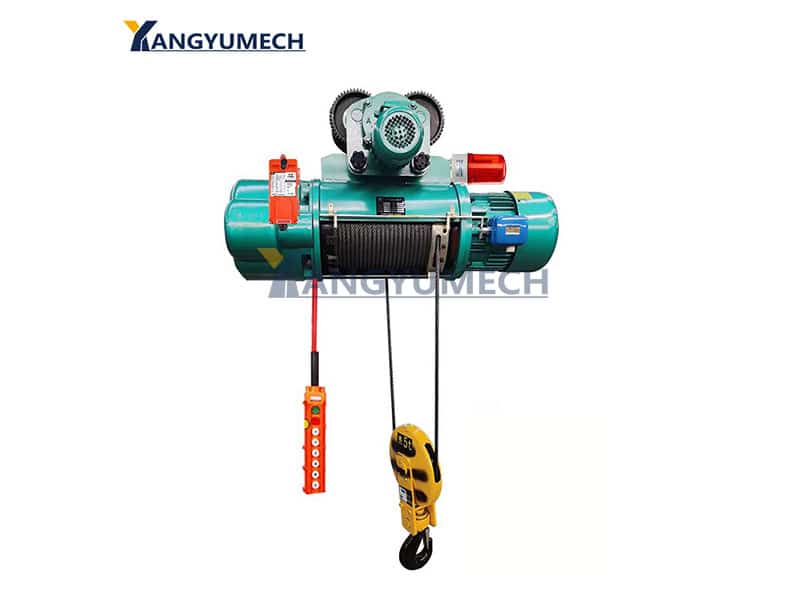
Traditional CD and MD hoists follow a design that originated in China and has been widely adopted across Asia and developing markets. CD hoists have a single lifting speed. MD hoists add a slow speed for precise positioning. The design is robust, simple to maintain, and uses proven components that are available from multiple suppliers.
The rope drum on a traditional hoist is shorter in diameter and longer axially than a European-style drum sized for the same lift height. This means the rope wraps in multiple layers, which is acceptable for many applications but causes faster rope wear and shorter rope life compared with a single-layer wrap. The hoist body is larger in the runway direction, which increases the end approach dimensions on the crane bridge.
Panel-mounted controls and contactor-based electrical systems are standard on traditional hoists. Variable frequency drives are available as an option but are not standard. For applications that do not require precise positioning or high-cycle duty, the simplicity of the traditional design is an advantage rather than a limitation.
Industry Applications: Where Each Type Fits?
European-style hoists dominate in industries where duty cycles are high, positioning precision matters, and equipment reliability directly affects production output. Automotive manufacturing uses European-style hoists for line-side handling, stamping die changes, and assembly operations where positioning accuracy and repeatability are required. The aerospace industry specifies European-style hoists for composite layup, engine handling, and final assembly because the variable frequency control protects sensitive and high-value components during lifting.
Steel service centers and metal processing facilities use European-style hoists for coil handling, plate handling, and continuous production lines where the hoist makes hundreds of cycles per shift. The FEM 4m and 5m duty ratings are designed for exactly these operating conditions. Wind power manufacturing uses European-style hoists for blade handling, nacelle assembly, and tower section positioning, where the low headroom and precise control are valuable in large assembly spaces.
Traditional CD and MD hoists remain the dominant choice for general manufacturing, maintenance workshops, warehouses, and light industrial applications where the hoist operates at a lower duty cycle and positioning precision is less critical. These hoists are cost-effective, simple to repair with basic tools, and parts are widely available. Many maintenance departments prefer traditional hoists specifically because the electrical system is contactor-based and the mechanical design is straightforward to service without specialized training or proprietary tools.
In the African, Southeast Asian, and South American markets, traditional CD and MD hoists are often the first choice because the local service infrastructure is oriented around these designs. The lower upfront cost and the ability to service the hoist with locally available components make the traditional design practical even for moderately demanding applications.
How to Choose Between the Two?
The decision comes down to three factors: how hard the hoist will work, how precisely it needs to position loads, and what your maintenance team can support. If the hoist will make more than 50 lifts per shift at or near rated capacity, European-style is the better long-term choice. If the hoist runs occasionally for maintenance or light production, a traditional CD or MD hoist delivers the same lifting capacity at a lower price.
Precise positioning favors European-style hoists because the variable frequency drive is standard. For applications where a two-speed hoist is sufficient, a traditional MD hoist with dual-speed control is a cost-effective alternative.
Yangyumech Hoist Product Range
Yangyumech manufactures both European-style and traditional hoists, giving you the right hoist for your application and budget. Our European-style wire rope hoists cover 1 to 80 tons with FEM duty ratings from 1Am to 5m, featuring modular design, single-layer rope drum, low headroom configuration, and variable frequency drives on all motions. Our European-style chain hoists cover 1 to 12.5 tons for workstations and light-duty applications.
Our CD and MD type wire rope hoists cover 1 to 50 tons for standard industrial applications. These hoists are robust, economical, and supported by a global service network with readily available spare parts.
We welcome inquiries from distributors, crane builders, and end users. Whether you need a single hoist for a workshop upgrade or a volume order for a crane manufacturing program, Yangyumech provides competitive factory pricing, complete technical documentation, and engineering support for crane integration and installation.