
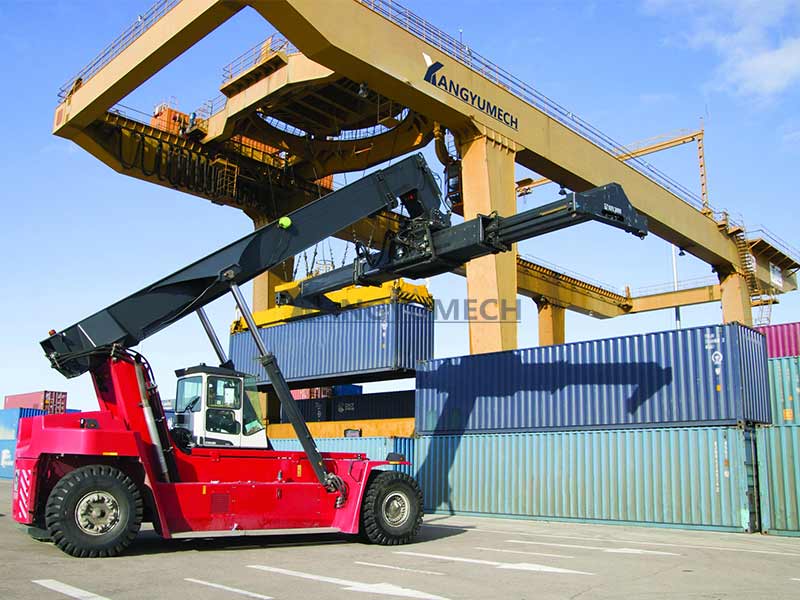
Walk into any modern container terminal and you will see rows of colorful stackers lifting boxes three, four, or five high. Most of them are not rail-mounted. They run on oversized rubber tyres and move freely across the yard. That machine is a rubber tyred gantry crane—an RTG crane for short—and it has become the workhorse of container handling yards worldwide.
What Is an RTG Crane
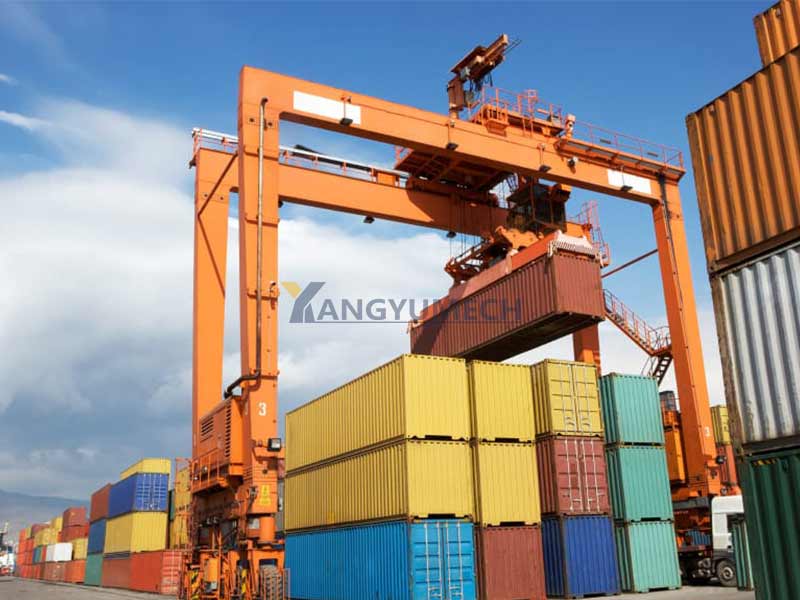
An RTG crane is a gantry crane that straddles a row of containers or a storage block and travels along the ground on rubber tyres instead of fixed rails. The bridge spans the container stack, a trolley runs across the bridge carrying the spreader, and the whole structure moves perpendicular to the stack along a defined lane. This lets a single RTG container crane pick, stack, and retrieve boxes across several rows without being tied to a rail line.
The term rubber tyred gantry crane is used throughout the industry and is effectively synonymous with RTG crane. What separates it from a rail-mounted gantry is mobility: because it rides on tyres, it can be moved between blocks, which gives terminal operators flexibility that fixed rail systems cannot match.
Types of RTG Cranes
RTG cranes are not all built the same, and the differences matter when you are matching a machine to your yard.
Power source is the first distinction. Diesel RTG cranes run on an onboard generator and operate anywhere with no fixed infrastructure. Electric RTG cranes—often E-RTG—draw power from a cable reel or conductor system and cut operating cost and emissions. Hybrid RTG cranes pair a smaller diesel engine with a battery or supercapacitor to reduce fuel use during hoisting, and for terminals with emissions or high-utilization targets the electric or hybrid RTG crane is increasingly the default.
Beam configuration is the second. A single beam RTG crane uses one main girder and suits lower stacking and lighter duty, while a double beam RTG crane uses two girders for greater rigidity where high stacking and continuous operation are required.
Spreader type is the third. A fixed spreader handles one container size. A telescopic spreader adjusts to 20-foot, 40-foot, or 45-foot boxes, which is what most commercial terminals need. Some RTG cranes are fitted with twin-lift spreaders that pick two containers at once to raise throughput.
RTG Crane vs RMG Crane: Which One Fits
The RTG crane vs RMG crane question comes up in almost every terminal planning discussion. An RMG crane runs on fixed rails and is typically used where stacking is high and the crane does not need to change blocks. RTG cranes trade some stacking height for yard flexibility. The main RTG crane advantages are mobility and the ability to serve multiple blocks or adapt to a changing yard layout. If you are building a dedicated high-bay line with a fixed footprint, an RMG crane may be more cost-effective per lift—but for most terminals, the RTG crane is the more adaptable choice.
Where RTG Cranes Work
The RTG crane application centers on container storage and movement.
The most visible is the container terminal, where an RTG container crane stacks import and export boxes in the yard between the quay and the gate. RTG crane for container terminal use is the dominant application worldwide because the tyres let the crane serve adjacent blocks without rail realignment.
An intermodal yard uses RTG cranes to transfer containers between road, rail, and storage, and RTG crane for intermodal yard operations handles the constant reshuffling between modes that keeps a terminal flowing. Ports and inland depots rely on RTG crane in port and depot settings for loaded and empty stacking, reefer handling, and gateway work—where the mobility of the rubber tyred gantry crane operation lets one machine cover more ground than a fixed crane of similar capacity.
The Specifications That Affect Your Decision
When reviewing RTG crane specifications, a few parameters decide whether the machine fits your yard.
RTG crane capacity typically runs from about 30 to 65 tons for standard container handling, with higher ratings for specialized loads. Match the rating to your heaviest container plus any attachment.
RTG crane stacking height—often written as “1-over-5” or “1-over-6”—defines how many containers the crane can stack, and this drives land-use efficiency against your yard footprint. RTG crane tyres are oversized pneumatic or solid tyres carrying the full structure; tyre life, pressure monitoring, and the steering system that holds the crane on its lane all affect uptime.
RTG crane safety systems—load monitoring, anti-collision, and automated steering—are now standard in most procurement specs. Confirm compliance with applicable FEM, ISO, or regional standards with the RTG crane manufacturer before ordering.
Why Buy Directly From an RTG Crane Manufacturer
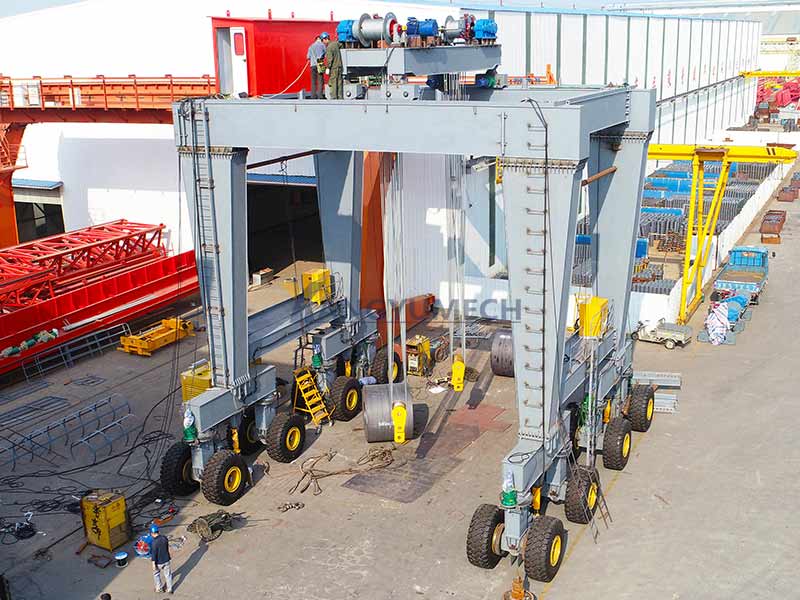
The RTG crane price you are quoted can vary widely depending on whether you buy through a distributor or directly from an RTG crane manufacturer. A manufacturer can supply certified structural calculations, match the configuration to your yard, and support custom adaptations such as extended span or special spreaders. Working directly with an RTG crane supplier also matters for spare parts and technical support once the crane is in service.
Yangyumech: Your RTG Crane Manufacturer
Yangyumech is a crane manufacturer with a product range covering RTG cranes, container gantry cranes, quay cranes, overhead bridge cranes, gantry cranes, jib cranes, and electric chain hoists. For terminal operators, that means a single supplier can cover the full lifting scope from quay to yard to workshop.
Every Yangyumech RTG crane is load-tested before dispatch and built under documented quality control aligned with FEM, ISO, and CE requirements. The engineering team works directly with your yard layout to match span, capacity, stacking height, power source, and spreader type to your actual operation rather than a catalog default.
For buyers comparing RTG crane price across suppliers, Yangyumech offers direct-to-end-user pricing that removes distributor margins. Getting a tailored quotation before you finalize the specification helps you avoid paying for capacity you will not use—or under-specifying in a way that limits throughput later.