
In port depots, logistics bases or large manufacturing workshops, gantry cranes (commonly known as gantry cranes) are indispensable backbone equipment. It is known for its strong handling capacity and efficient use of ground space. However, faced with the two main structural forms on the market-single beam and double beam, many project leaders are inevitably confused when choosing the type. These two types of cranes are not simple advantages and disadvantages, but precise solutions for different application scenarios. Understanding the core differences between them is the first step to ensure maximum return on investment and safe and efficient operations.
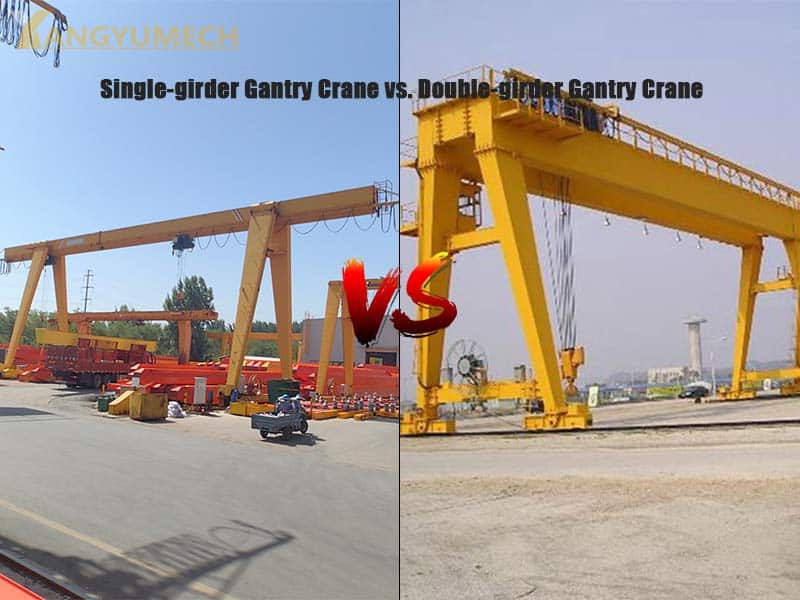
Structural Design And Carrying Capacity: Fundamental Differences
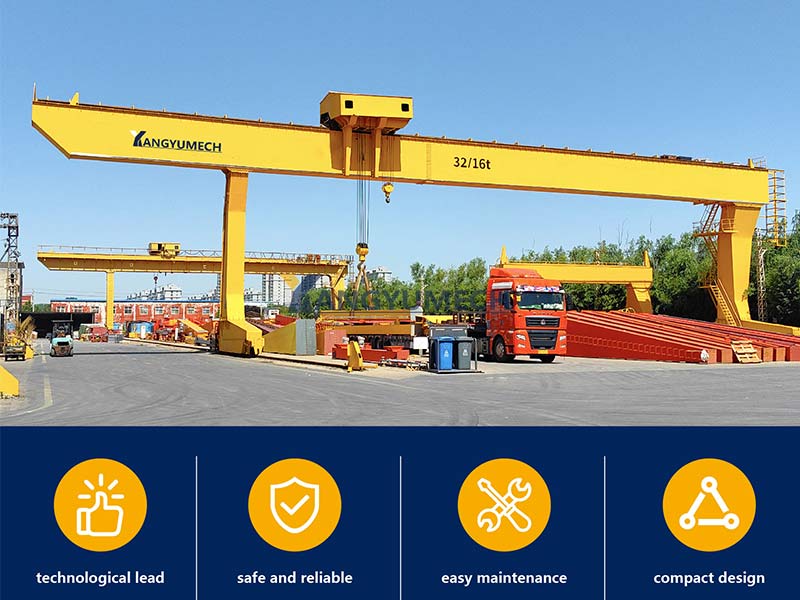
The most intuitive difference is the number of main beams. Single-beam gantry crane, as the name suggests, consists of only one main beam, and the structure is relatively simple. This design brings the advantages of light weight, low manufacturing cost, and easy installation. However, the overall stiffness and stability of a single-beam structure are relatively limited, which determines that its carrying capacity is usually suitable for light to medium-sized loads. The lifting range is generally from 1 ton to 20 tons, and it can reach 50 tons under a specific design.
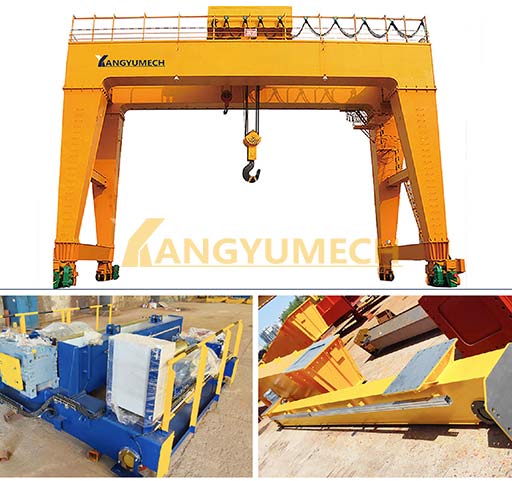
The double-beam gantry crane uses two parallel main beams to form an extremely stable support frame. This complex structure gives it excellent strength and rigidity, and can easily cope with heavy and even super-heavy lifting tasks, with a lifting capacity ranging from 5 tons to more than 500 tons. Therefore, double-girder cranes are the first choice for heavy-duty material handling fields such as steel, heavy machinery manufacturing, and large power stations.
Performance Characteristics And Applicable Scenarios: Demand-Based Trade-Off
Different structures directly lead to differences in performance. Because of its lightweight design, the single-girder crane has low headroom height requirements for the plant and saves vertical space. It is very suitable for renovation or installation in existing workshops or highly restricted sites. It is flexible in use and is commonly used in warehouses, small and medium-sized factories, and open-air cargo yards with low loading and unloading frequency.
The advantage of double-girder cranes lies in their powerful performance and wide adaptability. It not only has a large lifting weight, but also can achieve a larger span and a higher lifting height, and can cover a wider working area. In addition, its operation is more stable, with stronger anti-bias load and wind resistance, which is very suitable for continuous operation in heavy tasks, complex working conditions or outdoor wind and rain weather. In container terminals, large shipyards and heavy industrial construction sites, double-girder gantry cranes are almost standard configuration.
Economics And Long-Term Considerations: The Key To Comprehensive Decision-Making
From the perspective of initial investment, single-girder cranes are usually more economical in terms of procurement and installation costs. For projects with limited budgets or clear and moderate lifting requirements, they are a very cost-effective choice. However, due to the complex structure and more materials used in double-girder cranes, the initial cost is significantly higher.
However, decision-making cannot only look at the initial price. For heavy industrial scenarios that require high-frequency and high-load operation, the more durable characteristics of double-girder cranes mean longer service life, lower failure rates and higher overall operating efficiency, and their long-term investment value may be more prominent. On the contrary, long-term full-load use near the carrying limit of a single-girder crane may accelerate structural fatigue, increase safety risks and maintenance costs.
Make Your Choice: The Key Is Precise Matching
In summary, there is no “best” crane, only the “most suitable” crane. Your choice should be based on a clear assessment of the following factors:
Load weight and frequency: this is the decisive factor. For long-term handling of heavy materials of more than 20 tons or frequent operations, double beams are a more reliable choice.
Workplace conditions: consider the clearance height and span requirements of the plant and whether it is an indoor or outdoor environment.
Operating system and safety requirements: For occasions where high-strength and high-level safety standards (such as A5-A8 working level) are required, double-girder cranes are a more professional choice.
Total project investment budget: balance one-time investment with long-term operation and maintenance costs.
Choose Yangyumech, Choose a Professional And Valuable Partner
In the face of complex technology selection, an experienced and trustworthy partner is essential. As a professional gantry crane manufacturer, Yangyumech is well versed in the essence of single-beam and double-beam design. We not only provide high-quality products that meet international standards, but also are committed to providing customers with tailor-made solutions.
Our advantage lies in our precise engineering matching ability. Our technical team will analyze your specific working conditions, load curve and budget in depth to help you clarify your needs and avoid the waste of resources of “big horse-drawn cars” or the safety risks of “small horse-drawn cars”. Whether it is a cost-effective single-beam solution or a solid and durable double-beam system, we ensure that its design, materials and manufacturing technology can perfectly match your application scenario to achieve the best balance between performance and cost.
We sincerely invite our customers and partners to contact us. Let Yangyumech’s professional knowledge become part of your project, jointly choose the most suitable lifting equipment, lay a solid and reliable foundation for your production and operation, and work together to achieve a lasting win-win situation.