
Home » Products » Crane Parts » Container Spreader
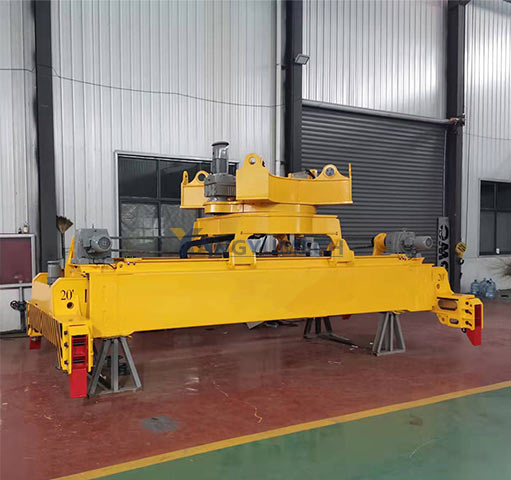
Container Spreader
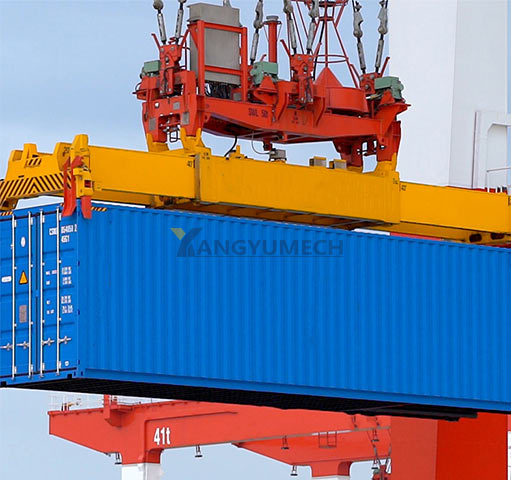
Container spreaders are essential specialized equipment used in loading and unloading operations at ports, yards, and on container ships. They are typically mounted on large cranes to safely and efficiently lift, transport, and stack standard containers.
Modern spreaders can automatically adapt to containers of various sizes (20-foot, 40-foot, 45-foot, etc.) and perform operations through the precise locking and release of corner blocks.
Description
Port Container Terminals: Primarily used on quay cranes (gantry cranes) to perform rapid loading and unloading of container ships. This is the scenario with the highest demands on lifting equipment efficiency and reliability; the equipment’s ability to quickly align with containers, provide precise anti-sway control, and lock in milliseconds directly determines vessel operation efficiency.
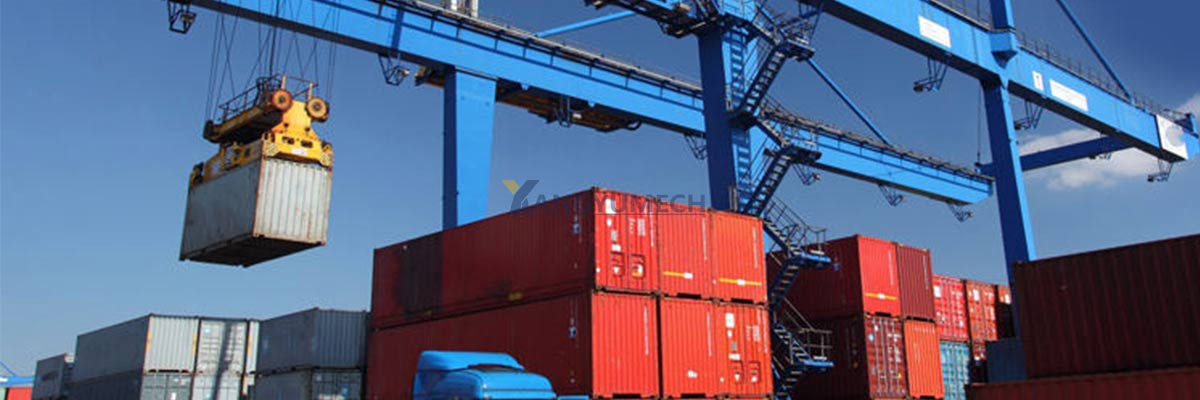
Container Yards and Rail Terminals: Used with rubber-tired or rail-mounted container gantry cranes (yard cranes) for stacking, transferring, and loading/unloading containers within the yard. The durability, maintainability, and compatibility of lifting equipment with automated systems are critical in these applications.
Intermodal Transport and Specialized Operations: Used with mobile machinery such as reach stackers and side-loading forklifts, as well as in special operating conditions like double-stack lifts and marine cranes, to achieve efficient and flexible container handling.
Features
Exceptional Reliability and Long-Life Design:
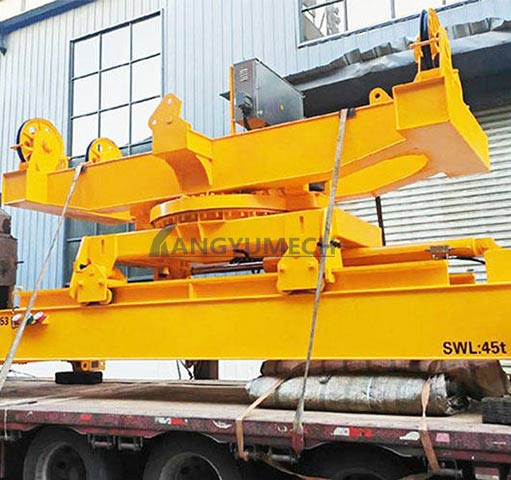
– Reinforced Core Components: Critical components—including torque locks, telescopic beams, and hydraulic/electrical elements—are manufactured from high-strength alloy steel and sourced from leading international brands. These components undergo millions of fatigue tests to ensure stable and reliable performance under the harshest continuous operating conditions, delivering industry-leading service life.
– Structural Optimization: The main frame utilizes high-strength steel plates and a box-section structure, which has been optimized through finite element analysis. This design achieves lightweight construction while maintaining strength, thereby increasing the crane’s payload capacity and reducing energy consumption.
Leading Intelligent Control and Efficiency Performance:
– Intelligent Anti-Sway System: Utilizing advanced electronic anti-sway algorithms, this system significantly reduces swaying of lifting gear and containers during hoisting and travel. It shortens the average operation cycle by 10–15%, substantially improving loading/unloading efficiency and safety.
– Millisecond-Level Locking and Position Detection: Equipped with high-precision sensors and fast-response valve assemblies/motors, locking and release operations are swift and reliable, with real-time status feedback to eliminate the risks of false locking and operational errors.
– Integrated Electrical Control System: Featuring a modular design for easy fault diagnosis, it supports seamless integration with the crane’s main control system and the Terminal Operating System (TOS), providing a solid foundation for automation and remote operation.
Comprehensive Customer Value and Service Support:
– Quick Replacement and Modular Design: The lifting equipment features standardized interfaces and a modular design, enabling rapid replacement of major components and significantly reducing maintenance downtime.
– All-Weather Adaptability: Sealing and material protection designs are engineered to withstand special environments such as salt fog, low temperatures, and high dust levels, ensuring stable operation in major ports worldwide.
– Full Lifecycle Services: We provide comprehensive lifecycle services ranging from customized solutions, installation and commissioning, and operator training to preventive maintenance, rapid spare parts supply, and technical upgrades. Through our data monitoring platform, we offer remote diagnostics and predictive maintenance recommendations to maximize your operational efficiency.
Our lifting equipment is not merely a handling tool; it is an intelligent solution designed to enhance your terminal’s productivity and safety standards.
Technical Data
| Container speader technical specifications | |||
|---|---|---|---|
| For operation with ISO standard 20’,40’, 45’ and twin 20’ containers | Control voltage | AC 380V/50HZ DC 24V(as agreed) | |
| Total power | ~8KW | ||
| SWL (Concentric/ Single mode) | 40T | Precaution class | IP 55 |
| SWL (Eccentricity / Twin 20’ mode) | 65T | Operating pressure of the system | 120bar |
| Load of lifting lugs at four corner | 19.5t×4 | Ambient temperature | -20℃ ~+55℃ |
| Self-weight (spreader) | ~13t | Twist lock Mode | ISO floating twist lock, driven by an oil cylinder |
| Expansion time (20’to 45’) | ~ 30 S | Telescopic Mode | The telescopic system is driven by means of a hydraulic motor and reduction gearbox connected to an endless chain. |
| Twist lock rotation 90° | ~ 1 S | ||
| Flipper through 180° | 5~7S | Flippers Device | The flippers are drived by hydraulic |
| Power voltage/ Frequency | AC 380V (3P)/50HZ | Application | Portal crane, Jib crane, QC, RMG, RTG |
| Operating mode | Control box with touch scrcen and Application Wireless remote | Electric Control | SIEMENS / Schneider |
Purchasing Process

FAQs About Choosing the Right Gantry Crane and Supplier
In order to obtain accurate quotes for custom overhead cranes, providing the following core information will greatly improve efficiency:
1. Key specifications: including rated lifting weight (tons), span (i.e., track spacing, meters), and lifting height (meters), which is the basis of the design.
2. Use environment and working conditions: Explain the conditions of the installation site (such as indoor/outdoor, temperature, humidity) and work level (busy level), which determines the material selection and configuration level of the structure.
3. Specific configuration requirements: clarify the drive mode (such as frequency conversion control), brand preferences for electrical components, safety devices (such as overload limiters, anti-collision systems), and whether special functions such as remote control are required.
4. Installation and service: confirm the on-site power supply conditions (voltage, frequency), installation conditions, and specific expectations for delivery time, installation and commissioning, and after-sales service.
The more detailed the information provided, the more accurate and reliable the solutions and quotations obtained.
1. Span and lifting capacity: this is the foundation.The larger the span and the higher the rated lifting weight, the material and design costs of the main beam and structure will increase significantly, and the higher the price.
2. Working level and frequency of use: The working level (A1-A8) represents the busy level and load status of the crane.Cranes with frequent and heavy-duty use require more durable motors, gearboxes and structural parts, and the cost is naturally higher than that of lightweight and occasionally used equipment.
3. Structure and configuration: The double beam is more complex and stable than the single beam structure, and the price is higher.At the same time, the lifting height, operating speed, motor brand, control system (ordinary vs frequency conversion), and the level of safety devices (such as anti-swing, load monitoring) all directly affect the final quotation.
4. Degree of customization and brand service: completely standard models have lower costs.The customized design based on the workshop environment (such as explosion-proof and high temperature), special processes (such as metallurgical special), brand added value, and after-sales guarantee system will all be reflected in the price.
In simple terms, when buying a bridge crane, it is necessary to consider “how much, how frequently, what environment and what configuration”, which determine its core value and price.
Which crane to choose mainly depends on your specific needs. You can quickly judge from the following four core aspects:
-Single-beam bridge crane: it is suitable for conventional workshops with light and medium loads (usually ≤20 tons), medium span, and low frequency of use. It is the most economical and versatile choice.
-Double-girder bridge crane: used for heavy-duty, long-span, or high-work-level occasions (such as frequent hoisting, metallurgy, heavy-duty assembly). Its stability, durability, and safety are higher, but the cost is also increased accordingly.
-Free vertical crane (cantilever/column type): suitable for fixed working points and working conditions with limited rotation range, such as beside machine tools, maintenance areas, or production line stations, it can efficiently use corner space and be installed flexibly.
-Grab crane: It is specially used for the handling, loading, and unloading of bulk materials (such as grain, coal, sand, and gravel). The only reason to choose it is that you need to deal with such unpackaged loose materials.
In simple terms, you can filter according to this logic:
First, according to the lifting weight and span, choose between a single beam and a double beam.
If the scope of operation is highly concentrated and the space is limited, consider a free vertical.
If the handling object is bulk material, it points directly to the grab type.
Yes. Our bridge cranes fully comply with and follow relevant international standards. Our company has passed a number of international certifications, such as the ISO 9001 quality management system, which guarantees that the management system ensures every aspect of the product, from design to delivery, is under high standards of quality control. Therefore, you can rest assured that our cranes are internationally competitive in terms of safety and quality.
In order to ensure the versatility, safety, and reliability of our products on a global scale, we strictly follow the mainstream international standard systems, including the International Electrotechnical Commission (IEC), European (EN/DIN), and the United States (ANSI/ASME) in the design and manufacturing process. For example, for the EU market, our products meet the detailed requirements of the Machinery Directive and CE certification. At the same time, we also actively adapt to specific regulations in other regions to meet the compliance needs of different customers.
Delivery times largely depend on whether the crane is standard or customized. Based on our experience, standard single-girder and double-girder cranes can be produced more quickly, while cranes with special spans, duty ratings, or environmental requirements naturally require additional engineering design time.
For each quotation, we provide an estimated production and delivery schedule based on your configuration and destination. Throughout the manufacturing process, our team maintains communication with the customer to ensure no unexpected issues arise before shipment.
Compared with many suppliers, Yangyumech mainly reflects the two differentiated advantages of high customization flexibility and clear international compliance when providing bridge cranes.
On the one hand, we focus on in-depth customized services. According to your specific needs, we can provide fully customized solutions on core parameters such as rated load capacity, span, and lifting height, and accept personalized requirements. This means that what you get is not a standard product, but exclusive equipment that accurately matches the working conditions of your workshop.
On the other hand, we attach importance to international standards and quality certification. Our products clearly meet the requirements of international certifications such as CE, which ensures that their safety and reliability can meet the mainstream standards of the international market, and provides you with additional quality confidence guarantees. Combined with our direct supply capabilities as a powerful factory, we can achieve better comprehensive value for you while obtaining compliant and customized products.
Hot Products
Single Girder Gantry Crane
- Capacity: 0.3t-36t; Span length: 4-35m
- Lifting height: 6m, 9m, 12m, etc.
- Raged voltage: 220V~690V
- Lifting height: 6m, 9m, 12m, etc.
- Raged voltage: 220V~690V
LD Single Beam Bridge Crane
- Single welding box girder
- Lifting Height: 5-50m
- Capacity: 1t-40t
- Lifting Height: 5-50m
- Capacity: 1t-40t
European Standard Electric Hoist
- Capacity: 1t-12.5t
- Working Class(FEM): 1Am-4m
- Lifting Height (m): 6/9 12/18
- Working Class(FEM): 1Am-4m
- Lifting Height (m): 6/9 12/18
Get In Touch
Yangyumech is a leading professional manufacturer of cranes in China. Our company integrates the processes of crane research and development, manufacturing, sales and service.