
Purchasing an overhead crane is a capital investment that directly influences productivity, facility layout, and operational efficiency. Pricing is rarely a single fixed figure. Instead, it is the result of multiple engineering decisions, structural considerations, and operational requirements.
Average Cost of an Overhead Crane System
The price of an overhead crane varies significantly depending on capacity, span, crane type, duty cycle, and installation complexity.
Below is a typical cost range for commonly deployed crane systems:
| Crane Type | Typical Capacity | Typical Span | Average Cost |
|---|---|---|---|
| Monorail Crane | 2 tons | 20 ft | $15,000 – $25,000 |
| Workstation Crane | 150 lbs – 2 tons | Up to 34 ft | $2,000 – $80,000 |
| Single Girder Bridge Crane | 5 tons | ≤ 40 ft | ~$40,000 |
| Double Girder Bridge Crane | 10 – 20+ tons | 40 – 80 ft | $65,000 – $100,000 |
| Semi-Gantry Crane | 5 tons | 40 ft | ~$130,000 |
| Full Gantry Crane | 5 – 20 tons | 40+ ft | $160,000 – $170,000 |
| Jib Crane | 150 lbs – 5 tons | 4 – 30 ft | $500 – $25,000 |
Installation typically adds $15,000 to $25,000, depending on structural complexity.
Primary Factors That Determine Overhead Crane Pricing
Overhead crane costs are determined by several engineering variables. Each variable directly influences structural requirements, mechanical design, and system complexity.
The most influential factors include:
– Crane type
– Span length
– Load capacity
– Service classification
– Runway length
– Operating environment
– Building structural requirements
Each factor contributes to material costs, fabrication complexity, and installation labor.
Crane Type and System Configuration
The configuration of the crane structure is one of the most decisive cost drivers.
Bridge Cranes
Bridge cranes are the most widely used overhead lifting system in industrial facilities. The bridge travels along runway beams installed on both sides of the building.
Two major configurations exist:
Single Girder Bridge Crane
Single girder cranes use one bridge beam supporting the hoist and trolley system.
Typical characteristics:
– Lower fabrication cost
– Suitable for light to moderate loads
– Smaller spans
– Reduced structural requirements
Average price: around $40,000 for a 5-ton, 40-foot system.
Double Girder Bridge Crane
Double girder cranes consist of two bridge beams supporting a top-running trolley.
Advantages include:
– Larger span capability
– Higher lifting capacities
– Greater hook height
– Increased duty cycle performance
Typical cost: $65,000 to $100,000+, depending on capacity and span.
Gantry Cranes
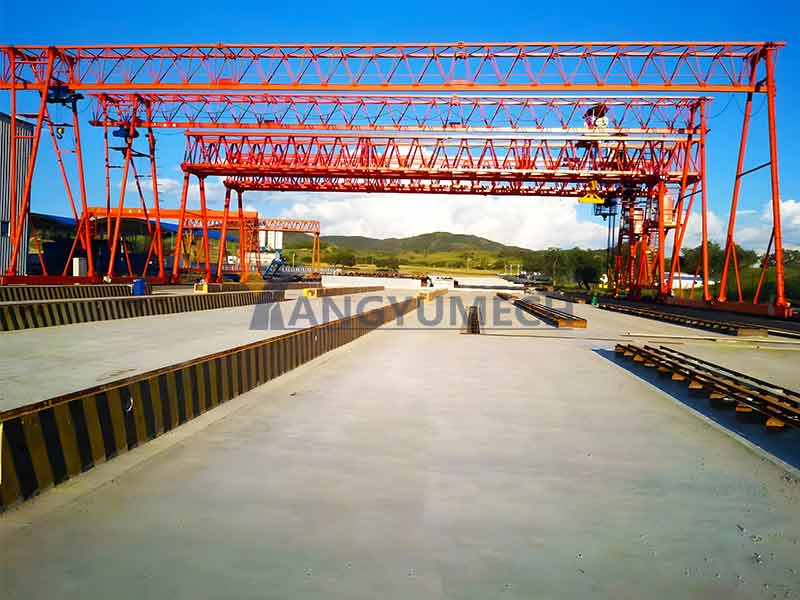
Gantry cranes differ from bridge cranes by using legs that support the bridge structure. These cranes run on floor-mounted rails instead of building columns.
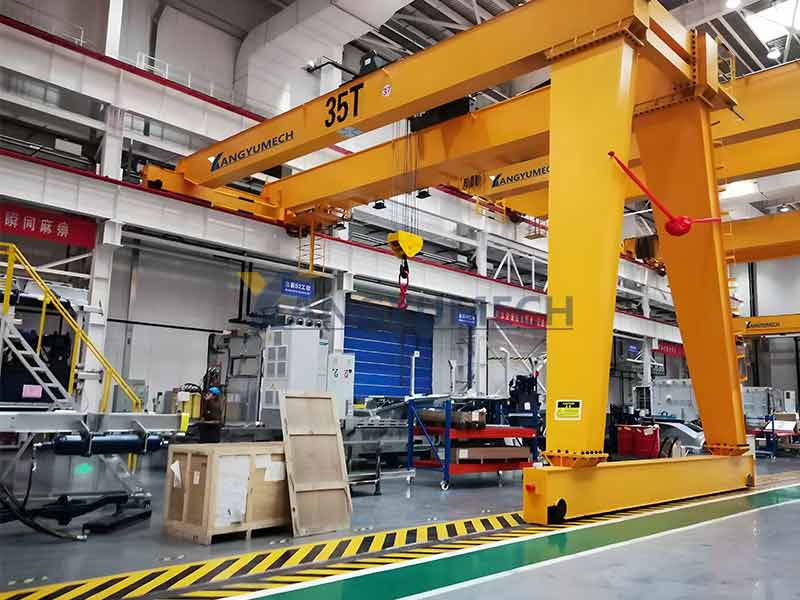
Semi-Gantry Cranes
Semi-gantry cranes use one runway beam supported by the building while the other side runs on floor rails.
Typical cost: around $130,000 for a 5-ton, 40-foot configuration.
Full Gantry Cranes
Full gantry cranes rely entirely on floor-mounted rails.
Average cost range:
$160,000 to $170,000 or higher
These systems require extensive structural support and rail infrastructure.
Monorail Crane Systems
Monorail systems are used for linear material transport within manufacturing processes.
Characteristics:
– Straight or curved tracks
– Point-to-point movement
– Lower capacity lifting
Typical configuration:
– 2-ton capacity
– 20-foot track
– Cost range: $15,000 to $25,000
The primary cost variable is the length of the track and support structure.
Workstation Crane Systems
Workstation cranes serve repetitive production environments such as assembly lines, machining cells, and packaging facilities.
Typical characteristics:
– Capacity from 150 lbs to 2 tons
– Bridge span up to 34 feet
– Modular track systems
– Ceiling-mounted or freestanding
Jib Cranes
Jib cranes provide localized lifting around a single workstation or machine.
Common types include:
– Freestanding jib cranes
– Wall-mounted jib cranes
– Mast-type cranes
– Workstation jib cranes
Specifications include:
– Capacities from 150 lbs to 5 tons
– Span range 4–30 feet
– Height under boom 8–30 feet
Typical price range: $500 to $25,000
Installation may require reinforced concrete foundations.
Crane Span and Its Impact on Price
Span refers to the horizontal distance between the runway rails that support the crane bridge.
Increasing span affects cost in multiple ways:
– Additional steel for girder construction
– Increased structural weight
– Larger runway beams
– More powerful trolley systems
Even modest increases in span can significantly raise material and fabrication expenses.
Crane Load Capacity
Load capacity is defined as the maximum rated load the crane can safely lift under specific conditions.
Capacity affects multiple components:
– Bridge beam thickness
– Hoist power
– Trolley design
– Structural reinforcement
– Runway beam sizing
For example:
– A 10-ton crane requires significantly larger structural members than a 5-ton crane.
– A 20-ton crane often requires a double girder configuration.
Runway System Length
The runway system supports the crane bridge and allows it to travel across the building.
Longer runways increase cost due to:
– additional rail material
– more structural supports
– increased electrical power systems
– expanded installation labor
Facilities requiring high travel speeds across long bays may also require larger drive motors, further increasing cost.
Operating Environment Considerations
Industrial environments significantly influence crane design and pricing.
Certain environments require specialized components or protective treatments.
Harsh Environmental Conditions
Common conditions that affect crane design include:
– extreme heat
– chemical exposure
– dust or abrasive particles
– moisture and humidity
– corrosive atmospheres
Solutions may involve:
– specialized coatings
– corrosion-resistant materials
– sealed electrical systems
– stainless or galvanized components
Explosion-Proof Crane Systems
Industries such as oil and gas processing, wastewater treatment, and fertilizer manufacturing often require explosion-proof cranes.
These systems prevent ignition by eliminating sparks through:
– pneumatic air-powered systems
– explosion-proof electrical components
Such systems require specialized engineering and significantly increase system cost.
Structural Requirements of the Building
The building itself must support the loads generated by the crane system.
When installing cranes in existing facilities, structural engineers must verify:
– column load capacity
– runway beam support
– foundation strength
– building deflection limits
If structural reinforcement is required, costs can increase dramatically due to:
– additional steel structures
– foundation upgrades
– structural engineering consultations
Installation Costs
Crane installation costs vary depending on:
– crane size
– structural modifications
– access conditions
– installation height
– existing equipment removal
Typical installation costs range between:
$15,000 and $25,000
However, complex installations can exceed this range.
Overhead Crane Quotation Timeline
The crane quotation process usually takes 3 to 30 business days depending on the complexity of the system.
A typical proposal involves collaboration between:
– engineers
– estimators
– project managers
– designers
– crane specialists
During this phase, they finalize system specifications, structural requirements, and pricing.
Key Cost Drivers for Overhead Crane Projects
Among all factors, two variables dominate crane pricing:
1. Crane span
2. Load capacity
These parameters determine:
– material requirements
– girder design
– hoist power
– runway structure
– control system complexity
Once these are established, the remainder of the system configuration follows.
Final Cost Planning Insights
Budgeting for an overhead crane requires careful analysis of operational needs, facility constraints, and long-term production goals.
When properly engineered, a crane system becomes a productivity engine capable of serving a facility for decades.
Understanding the core variables — crane type, span, capacity, duty cycle, and structural requirements — allows companies to plan capital investment accurately while ensuring maximum operational efficiency.
No matter what special challenges your project faces-restricted installation space, harsh environmental conditions, or unique process flow, Yangyumech’s engineering team can provide technically feasible and economically reasonable crane solutions. Welcome to contact our technical consultants to obtain customized solutions for the characteristics of your project.