
When floor space is tight and you need full coverage for moving loads without installing two rows of columns, a semi-gantry crane often becomes the smartest investment.
Also called a single-leg gantry crane, it runs with one leg on an elevated runway attached to a building’s columns or a wall bracket, while the other leg travels on a ground-level rail.
This hybrid design sits between a classic overhead bridge crane and a full gantry system, cutting civil engineering costs and making the most of existing structures.
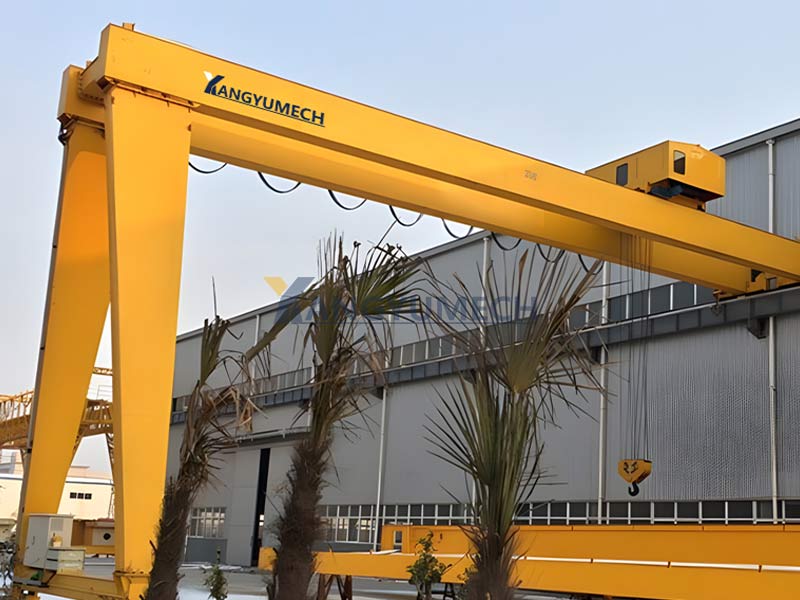
Primary Applications of Semi-Gantry Cranes
In machinery manufacturing and assembly halls, it is common to find one bay equipped with full-height columns for an overhead crane while the adjacent bay only has support on one side.
A workshop semi gantry crane fills this gap perfectly.
The building-side end runs on the original crane girder or a newly installed bracket, and the floor leg rolls on a rail cast into the concrete.
This setup is ideal for engine assembly lines, injection mold change stations, and work cells where components must move directly between storage racks and production equipment.
Because it removes the need for extra foundations and steel structures, the workshop semi gantry crane shortens installation time and reduces total investment.
Outdoor environments benefit just as much. Steel service centers and pipe mills routinely place an outdoor semi gantry crane along a warehouse wall, using a cantilever extension to load and unload flatbed trucks from the yard side.
The open span lets operators handle long bundles, plates, and coils without confinement.
These cranes come with weatherproof motors, rain canopies, and storm brakes, keeping performance consistent through seasonal changes.
Precast concrete plants represent another heavy-use sector. Here, a double girder semi gantry crane with a higher lifting capacity moves forms and finished panels across casting beds.
The semi-gantry layout leaves the bed area unobstructed, simplifying stripping and yard management.
Wind turbine tower fabricators and ship block assembly shops also select high-capacity semi-gantry designs to rotate and position heavy sections without interfering with overhead cranes running in neighboring bays.
Maintenance depots and rail yards complete the picture, where compact semi-gantry cranes lift engines and bogies inside existing repair sheds.
Common Types of Semi-Gantry Cranes
Most semi-gantry cranes divide into two main structural families: single girder and double girder.
A single girder semi gantry crane pairs a rolled steel beam with an electric wire rope hoist that rides on the bottom flange.
It remains lightweight, economical, and quick to install, typically handling capacities between 1 ton and 20 tons with spans up to 25 meters.
This type serves small-to-medium workshops, warehouse despatch areas, and assembly cells.
When the application calls for a cantilever, motorized trolley, or radio remote control, the single girder platform adapts easily, making it the first option for many buyers looking for a custom semi gantry crane solution.
For heavy lifts, a double girder semi gantry crane uses two main beams and a crab trolley running on top rails.
Capacities normally begin at 10 tons and can exceed 50 tons, while the trolley arrangement gains extra hook height compared with a single girder design.
Steel distribution centers, heavy fabrication bays, and outdoor slab yards depend on double-girder models for their rigidity and long-term durability under frequent use.
These cranes frequently include maintenance walkways, festoon cable systems, and variable frequency drives for smooth load positioning.
For extremely wide spans, manufacturers may also propose a truss girder semi-gantry crane to reduce dead weight without sacrificing stiffness — a design detail worth discussing during the quotation stage.
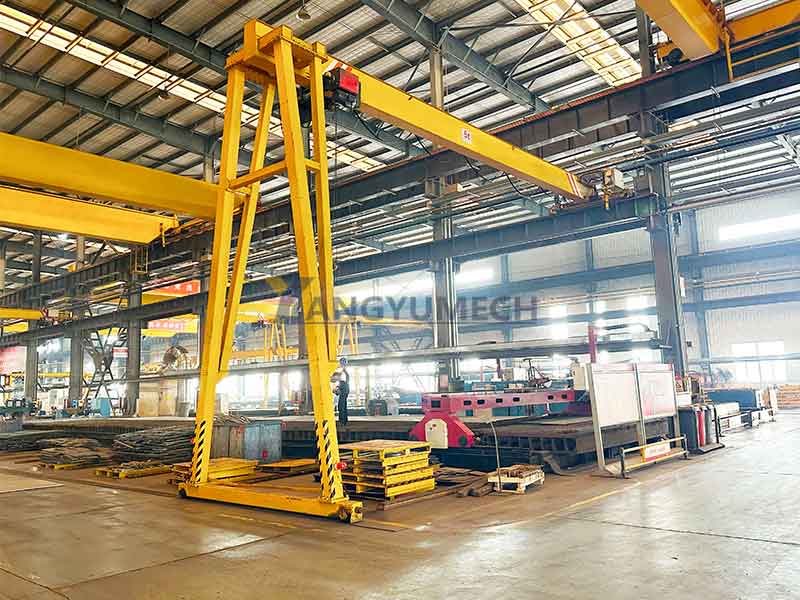
Key Parameter Ranges to Define Your Crane
When outlining a project, most inquiries start with semi gantry crane lifting capacity. Standard models cover a range from 1 ton up to 50 tons.
Engineered heavy-lift configurations can reach 80 tons or more for specialized handling. The span — measured between the floor rail centerline and the building-side runway — typically spans from 6 meters to 30 meters.
If your layout demands a longer reach, the design may shift to a truss girder or require additional reinforcement.
Lifting height varies with building clearances, commonly falling between 6 meters and 18 meters.
In high-bay facilities where the trolley sits above the double girders, the hook path increases, giving extra headroom.
Duty classification drives component selection.
Light and medium service workshops often use FEM/ISO class A3 to A5, while steel mills, foundries, and two-shift operations demand A6 or A7 ratings.
Hoisting speeds can be as low as 0.8/5 m/min on a two-speed hoist for precise mold handling, or fully variable from 0.4 to 6 m/min through inverter control.
Cross travel and long travel speeds typically range from 3 to 30 m/min, tuned to the length of the runway and the need for rapid cycle times.
Power supply systems differ by location — indoor units favor enclosed conductor bars or flat cables, whereas outdoor semi gantry crane designs rely on cable reels or festoon systems with UV-resistant sheathing.
Because every jobsite has its own constraints, these semi gantry crane specifications should always be confirmed through detailed site measurements and operational data.
Partnering with a Professional Manufacturer
When you source a semi gantry crane for sale directly from an original equipment manufacturer, you remove unnecessary distribution layers and gain access to engineering support that generic resellers simply cannot provide.
Yangyumech operates a modern manufacturing base in China and has spent over a decade designing, fabricating, and commissioning semi-gantry crane systems for markets across Asia, the Middle East, Europe, and the Americas.
Our facility integrates ISO-certified processes, European-brand drives and hoists, and full-load testing before shipment.
Whether you need a standard 5-ton single girder workshop semi gantry crane or a customized 30-ton double girder outdoor unit with a cantilever, our engineers will match the structure, controls, and safety features to your exact building drawings and usage patterns.
We offer factory-direct pricing, transparent lead times, and responsive after-sales support, which makes Yangyumech a trusted Chinese semi gantry crane manufacturer among equipment distributors, project contractors, and end users worldwide.
We warmly welcome dealers, construction groups, and industrial buyers to reach out for a detailed consultation and quotation. Visit our website or send us your lifting requirements today — let’s build a crane that works as hard as you do.