
When a facility needs to move heavy loads across a wide span but cannot commit to a permanent overhead crane installation, the mobile gantry crane is usually the answer that comes up next. It handles the same kind of lifting work as a bridge crane but without the runway beams, rail tracks, or structural modifications to the building—and that simplicity of installation is what draws so many operations to it. The uses of mobile gantry crane equipment span construction, industrial, mining, port, and logistics applications, with the mobile gantry crane benefits—speed of setup, no structural commitment, and flexible repositioning—appealing to operators who need capacity without the overhead of a fixed installation.
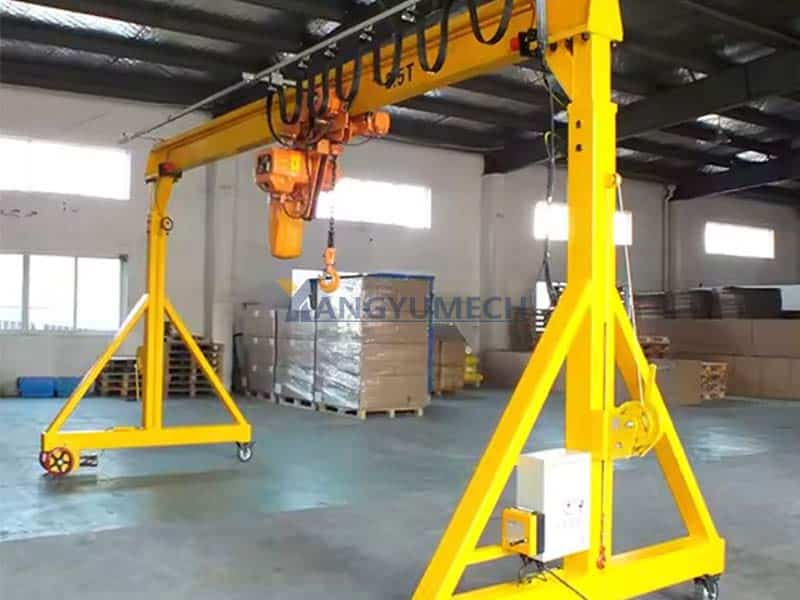
Where Mobile Gantry Cranes Are Mainly Used
The mobile gantry crane applications span a broader range of industries than most buyers expect, which is partly a reflection of how versatile the basic concept is.
In construction, a mobile gantry crane for construction site work handles material placement, steel member positioning, and precast element installation across the full build cycle. Sites that do not justify a tower crane—or that need to move the lifting point frequently within the same project—find that a mobile gantry crane on site provides enough capacity for most structural lifts without the commitment of a fixed installation.
In industrial settings, the mobile gantry crane for industrial use serves workshops, fabrication yards, and manufacturing facilities where the lifting pattern changes as product lines shift or where the building structure cannot support overhead crane runway loads. A facility that moves heavy equipment in and out of a building, or that needs to shift the lifting point across a wide span, typically finds that a mobile gantry crane delivers the required capacity without structural reinforcement to the existing building.
In mining and quarrying operations, a mobile gantry crane for mining work handles equipment changeouts, conveyor component replacement, and material handling in areas where the work face moves regularly. Fixed crane installations are impractical in open-pit environments because the work geometry changes as the pit deepens. A mobile gantry crane can be repositioned to match the current working area without the cost of modifying a permanent installation.
In port and logistics environments, the mobile gantry crane for port operations and the mobile gantry crane for logistics applications handle container stacking, cargo loading, and yard transfers where a full rail-mounted system is not justified by the throughput volume. Many smaller ports and inland waterways terminals rely on mobile gantry cranes as their primary handling equipment because the capital cost is lower than a fixed installation and the crane can be redeployed to different berths as demand changes.
The question of where to use mobile gantry crane equipment comes down to one practical consideration: if the lifting work is heavy enough to need a crane but the layout or the project duration does not justify a fixed installation, a mobile gantry crane is almost always the right answer.
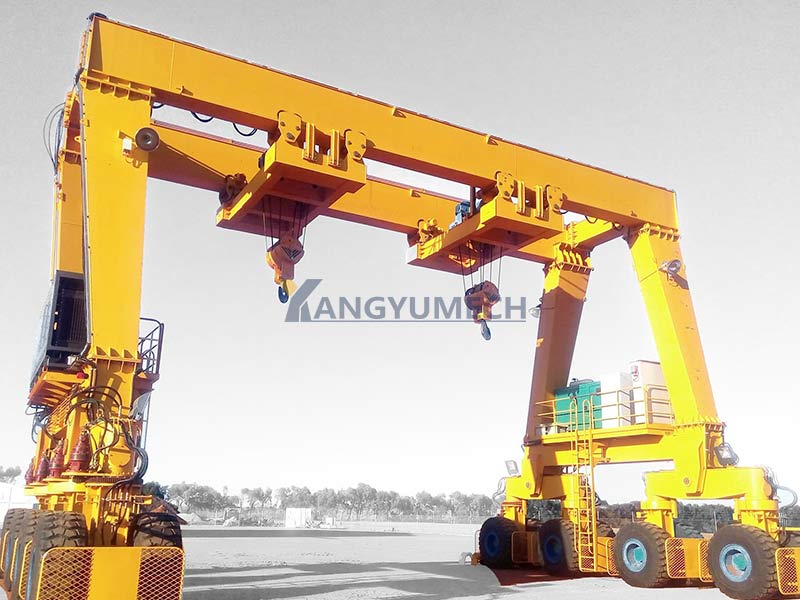
Types of Mobile Gantry Cranes
The types of mobile gantry cranes divide into two main categories, and the choice between them is driven by ground conditions, travel distance, and how often the crane needs to move between locations.
A rubber tyred gantry crane—commonly referred to as an RTG—is mounted on pneumatic tyres and moves under its own power within the site without fixed rail tracks. The rubber tyred gantry crane is the most flexible option for operations that need to reposition the crane frequently across different working areas. RTGs are typically diesel-powered or hybrid diesel-electric, and the tyre configuration determines whether the crane can travel on paved surfaces, unpaved ground, or both. For port terminals and large logistics yards, the RTG is the most common mobile gantry crane configuration because it can move between stacking blocks without assistance.
A rail mounted gantry crane—sometimes called an RMG—sits on fixed rails that run the length of the crane’s operating corridor. While this sounds like a fixed installation, the distinction is that the crane travels along the rail rather than being permanently positioned, which means it can serve multiple bays within its span without a separate lifting system. Rail mounted gantry cranes are most common in dedicated container terminals and high-throughput logistics facilities where the movement pattern is predictable and the rail infrastructure is already part of the site design.
For buyers comparing types of mobile gantry cranes, the decision typically comes down to whether the crane needs to leave its operating corridor. If it does, an RTG is the answer. If the crane operates within a fixed lane, a rail-mounted gantry crane offers higher speeds and heavier load ratings for the same structural investment.
Key Specifications That Matter
The mobile gantry crane specifications that buyers focus on first are lifting capacity, span width, and lift height—but the numbers that actually determine whether a crane fits the job are the ones that require some reading beyond the headline figures. Beyond those basics, the mobile gantry crane advantages include faster installation than a fixed overhead crane, lower civil works cost, and the ability to redeploy the equipment across different sites as requirements change.
Lifting capacity is the maximum load the crane can handle at its optimum configuration, typically at minimum radius and minimum height. The mobile gantry crane lifting capacity in most commercial configurations ranges from 5 tons to 200 tons, with specialised heavy-lift models going beyond 500 tons for specific industrial applications. For most construction, industrial, and port applications, the 20-ton to 100-ton range covers the majority of procurement requirements.
Span width—the distance between the two gantry legs—is determined by the bay geometry and the size of the loads being moved. Common spans range from 5 metres to over 30 metres, and the span affects the structural section size and the cost of the crane more directly than any other parameter.
Lift height determines how high the load needs to travel above the ground or floor level, which drives the boom or hoist configuration. For most port and logistics applications, lift heights of 6 to 12 metres are standard. Industrial applications with multi-tier storage or mezzanine access may require lift heights of 15 metres or more.
Power source matters operationally: diesel gives the most flexibility for sites without reliable electrical supply, while electric-powered RTGs offer lower operating costs in facilities where grid power is consistent.
Yangyumech: Your Mobile Gantry Crane Manufacturer
Yangyumech is a lifting equipment manufacturer covering mobile gantry cranes, rubber tyred gantry cranes, rail mounted gantry cranes, overhead cranes, electric chain hoists, wire rope hoists, and aerial work platforms—supplying complete handling systems for construction sites, industrial facilities, ports, logistics hubs, and mining operations under a single specification and a single point of contact.
Every Yangyumech mobile gantry crane is load-tested and inspected before dispatch, with structural welding, electrical systems, and drive components verified against documented quality procedures. The engineering team works from your site layout and load specification directly—matching span width, lifting capacity, lift height, and power configuration to your actual operating conditions rather than recommending a standard model that is over- or under-specified for the job.
Working with an experienced mobile gantry crane supplier means faster response on spare parts, load charts, and field service support—the kind of after-sales infrastructure that makes a real difference when the crane is running a busy shift. Yangyumech offers direct-to-end-user pricing that removes the distributor margin, which is how the same build quality reaches you at a more competitive mobile gantry crane price. A tailored quotation before you finalise the specification helps you avoid paying for span or lifting capacity you will not use.