
A mobile gantry crane gives you lifting power without the commitment of fixed rails. You roll it where the load is, pick up, and wheel it to where the load needs to be. That sounds simple — but only when you match the right mobile gantry crane types to the right job. The range runs from a 0.5-ton shop floor unit to a 500-ton port-side behemoth. Getting the type, capacity, and application right is what separates a smart purchase from an expensive mistake .
How a Mobile Gantry Crane Differs From a Fixed Unit
A fixed gantry crane runs on embedded rails. It covers one span, one travel path, and that is it. A mobile gantry crane breaks that constraint. Smaller units roll on polyurethane casters or pneumatic tires. Larger ones travel on rubber tires (RTG) or on steerable wheels along any paved surface. The trade-off is stability: a mobile unit needs a flat, engineered surface and careful attention to wheel loading and center of gravity.
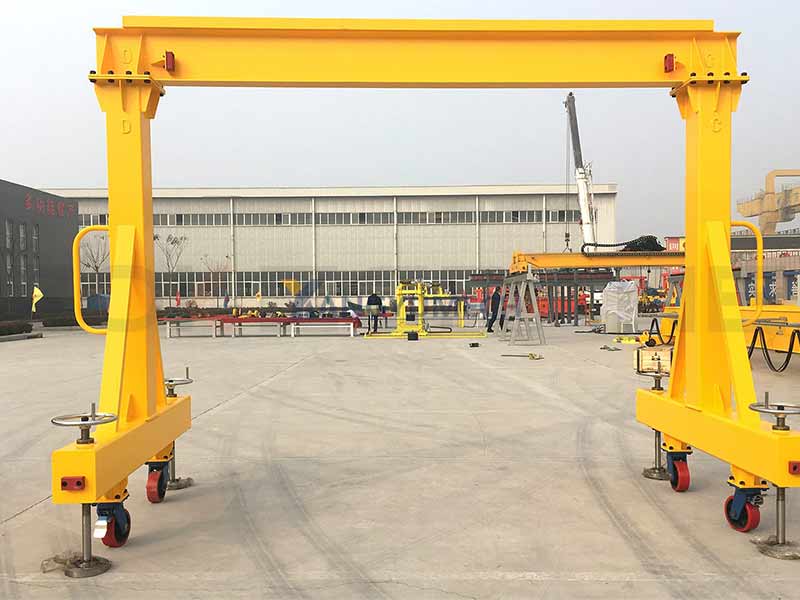
Main Mobile Gantry Crane Types
The lightest category is the light duty mobile gantry crane — typically 0.5 to 5 tons. These units have a steel frame gantry crane or an aluminum frame gantry crane, often with adjustable height gantry crane design, and a manual or electric chain hoist. They roll on casters and are pushed by hand or towed. Workshops, equipment maintenance bays, and small warehouses use them for occasional lifts where a permanent overhead crane is not justified.
The next step up is the heavy duty mobile gantry crane from 5 to 30 tons. These units run on rubber tires or steel wheels, often with a diesel-hydraulic power pack or an electric drive powered by a cable reel or onboard battery. They serve fabrication shops, precast concrete yards, and steel distribution centers where the lifting point changes from week to week.
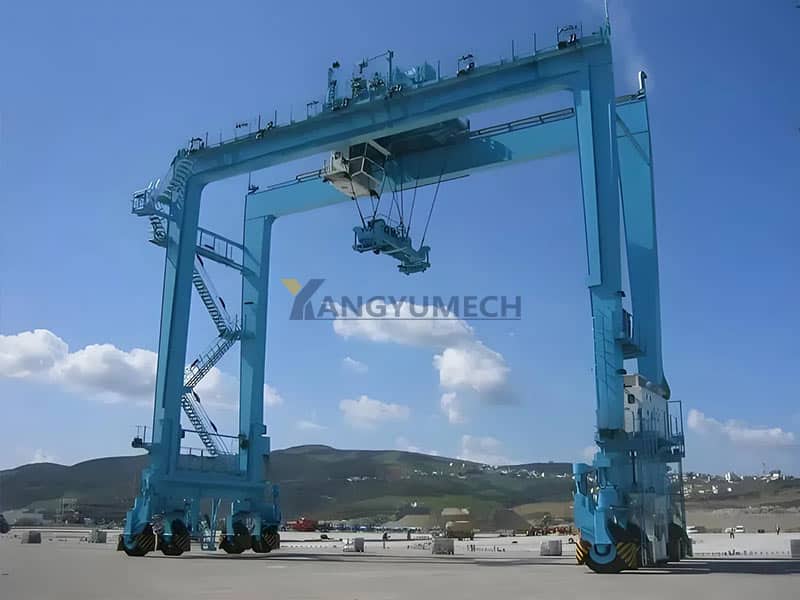
At the top end is the port mobile gantry crane — the rubber tired gantry crane, or RTG crane, used in container terminals and intermodal yards. An RTG stacks containers up to 1-over-5 or 1-over-6 high, spans six rows of trucks plus a lane, and lifts 40 tons per container. It is diesel-electric, with automated steering systems that keep the crane aligned within millimeters despite traveling on rubber tires.
Port Mobile Gantry Crane Applications
A port mobile gantry crane is built for one thing: moving containers fast. This container terminal crane handles loading, unloading, stacking, and reshuffling. The steering system reads paint lines or magnetic spikes embedded in the pavement. Some newer RTGs are fully electric — powered by busbar or cable reel — to cut diesel consumption and emissions in terminals near residential areas.
Key parameters for a port mobile gantry crane are stacking height (typically 5-plus-1 or 6-plus-1), stacking width (5 to 7 rows plus one truck lane), and travel speed (up to 130 m/min unloaded). The spreader is a telescopic frame that locks onto the container corner castings. An experienced RTG operator can complete a single pick-cycle in under 90 seconds.
Small Load Capacity Mobile Gantry Crane Cost and Buying Guide
The mobile gantry crane load capacity you choose drives the entire purchase. For light-duty applications, the small load capacity mobile gantry crane cost is far lower than installing a fixed crane. A 1-ton adjustable-height steel-frame unit with a manual chain hoist might cost $1,500 to $4,000. Add an electric chain hoist and the price moves to $3,000 to $7,000. An aluminum frame costs more but weighs less and resists corrosion — a good choice for outdoor or coastal sites.
When you set out to buy a mobile gantry crane, the mobile gantry crane buying guide comes down to three questions.
First, what is the maximum load you will actually lift — not the maximum you think you might lift someday. Over-specifying capacity means paying for a heavier frame, bigger casters, and more effort to move it.
Second, what is the height? Measure the tallest obstruction in your working area and add at least 500 mm for sling clearance.
Third, how often will you move it, and over what surface? Pneumatic tires handle rough floors; polyurethane casters suit smooth concrete.
Check the duty cycle. A mobile gantry crane used for five lifts a day does not need FEM 3m duty class. But if it runs continuously through a shift, specify a higher duty class and an electric hoist with thermal protection. Always ask for the load test certificate — a reputable manufacturer tests every unit to 125 percent of rated capacity before shipping.
Mobile Gantry Crane Applications Across Industries
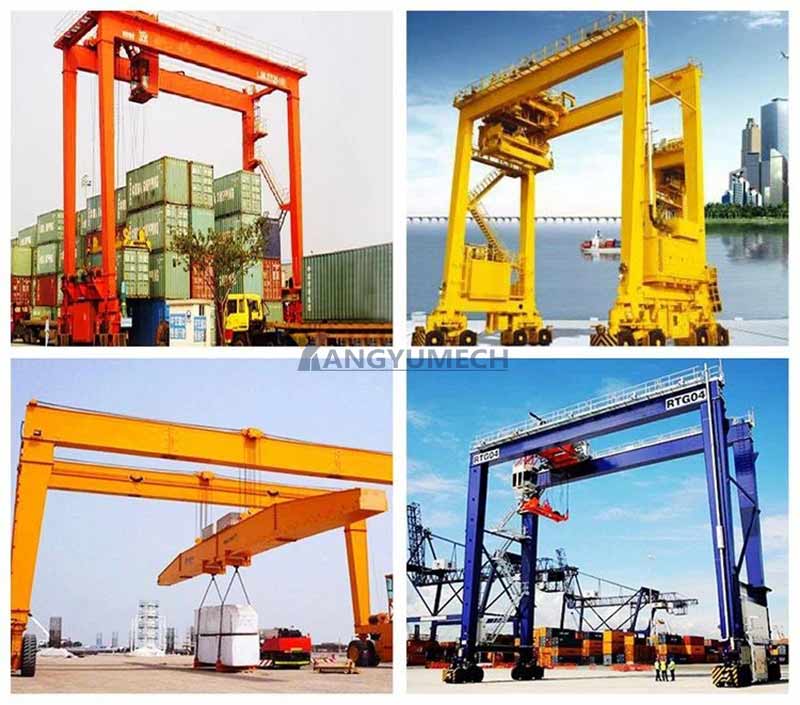
Mobile gantry crane applications span a wide range of industries. Manufacturing plants use them for assembly line feeding and mold changing. Construction sites deploy them for lifting prefabricated components. Mining operations use heavy-duty units for equipment maintenance in remote locations. Shipyards rely on them for section lifting where the build position shifts as the vessel takes shape. Wind energy installations use them for blade and nacelle handling during maintenance.
Why Yangyumech
Yangyumech is a gantry crane manufacturer building mobile gantry cranes from 0.5 to 500 tons. The product line includes light-duty steel and aluminum frame units with electric or manual chain hoists, medium-capacity rubber-tired cranes with diesel-hydraulic or electric drive, and full RTG port cranes for container terminals. Every Yangyumech mobile gantry crane is designed to FEM and ISO standards, load-tested at the factory to 125 percent of rated capacity, and shipped with complete documentation.
The Yangyumech engineering team helps buyers select the right capacity, frame material, hoist type, and steering system for the actual working conditions. For port operations, Yangyumech offers RTG configurations with automated steering, telescopic spreaders, and electric drive. For light-duty applications, the team provides cost-effective steel and aluminum frame designs with customizable height and span.