
Home » Products » Gantry Crane » Ship To Shore Container Crane

Ship To Shore Container Crane
Ship‑To‑Shore Container Crane (STS crane / quay container crane) is heavy‑duty rail‑mounted gantry equipment installed on port quay, dedicated for loading and unloading ISO containers between container ships and shore terminals.
Yangyumech, professional Chinese OEM manufacturer, delivers custom‑engineered STS solutions covering Panamax, Post‑Panamax and Super Post‑Panamax specifications for ULCV ultra‑large container vessels.
Our ship‑to‑shore cranes support manual, semi‑automated and fully‑automated operation modes, improving vessel turnaround efficiency for greenfield and brownfield container terminals worldwide.
Description
Ship-to-Shore (STS) Cranes are large dockside gantry cranes found at container terminals for loading and unloading intermodal containers. Generally classified by their lifting capacity and the size of the container ships they deal with, additional parameters indicate traveling and lifting speeds, the faster the better to minimize “deadtime” and be more efficient and profitable. Operators sit in a cabin suspended from the trolley, which runs along rails over the ship to lift the cargo. Once the spreader locks onto the container, the container is lifted, moved over the dock, and placed on the chassis either for direct shipment or to the storage yard.
Types of Ship-to-Shore (STS) Cranes:
Standard Ship-to-Shore (STS) Cranes:
Designed for traditional container handling operations.
Suitable for Panamax and Post-Panamax vessels.
Super Post-Panamax Cranes:
Built for Ultra-Large Container Vessels (ULCVs) with greater outreach and lifting capacity.
Capable of handling 22+ rows of containers.
Automated Ship-to-Shore (STS) Cranes:
Fully or semi-automated for increased efficiency and reduced labor costs.
Often used in highly automated terminals like those in Rotterdam or Singapore.
Typical Application & Terminal Working Conditions
Our ship‑to‑shore STS container cranes serve the following scenarios:
‑ Greenfield new‑build deep‑water container terminals
‑ Brownfield port expansion & terminal upgrading projects
‑ Large‑scale seaport container berths handling Panamax / Post‑Panamax / ULCV vessels
Working environment: open marine quay, salt fog, strong wind condition; supports 24/7 continuous heavy‑duty port operation.
Working duty: A7‑A8 heavy‑duty classification for high‑cycle container loading‑unloading tasks.


Features
1. High‑efficiency container loading & unloading for quay‑side terminal, shorten vessel berthing time and improve port cargo throughput.
2. Advanced automation solutions: remote control, semi‑autonomous operation, compatible with Terminal Operating System (TOS) for real‑time workflow optimization.
3. Regenerative power system to recycle energy during lowering & braking, matched with VFD variable frequency drives for smooth, energy‑saving motor control.
4. Marine‑grade heavy‑duty structure, anti‑corrosion design for salt‑spray coastal harsh environment, long service life and low downtime.
5. Comprehensive safety protection: anti‑collision system, overload protection, wind‑speed monitoring device.
6. Ergonomic operator cabin with wide‑view observation and optimized human‑machine control interface.
Technical Data
| Main Technical Parameters | |||||||||||
|---|---|---|---|---|---|---|---|---|---|---|---|
| Basic Parameters | Rated Lifting Capacity | Under Spreader | 35 | 41 | 51 | 65 | t | ||||
| Under Hook | 45 | 50 | 61 | 75 | t | ||||||
| Lifting Height | Above Rail | 37 | 25 | 50 | 35 | 58 | 40 | 62 | 42 | m | |
| Below Rail | 12 | 15 | 18 | 20 | m | ||||||
| Front Outreach | 30 | 45 | 51 | 65 | m | ||||||
| Rear Outreach | 10 | 15 | 15 | 25 | m | ||||||
| Rail Gauge | 16 | 16/22 | 30.48 | 30.48 | m | ||||||
| Total Trolley Travel Distance | 56 | 76/82 | 96.48 | 120.48 | m | ||||||
| Inside Clearance Between Legs | ≥17.5 | ≥17.5 | ≥18.5 | ≥18.5 | m | ||||||
| Clear Height of Middle Cross Beam | ≥13 | ≥13 | ≥13 | ≥13 | m | ||||||
| Distance Between Gantry Bumpers | ≤27 | ≤27 | ≤27 | ≤27 | m | ||||||
| Speed Parameters | Lifting Speed | Full Load | 50 | 60 | 75 | 90 | m/min | ||||
| No Load | 120 | 120 | 150 | 180 | m/min | ||||||
| Trolley Traveling Speed | 180 | 210 | 240 | 240 | m/min | ||||||
| GantryTraveling Speed | 45 | 45 | 45 | 45 | m/min | ||||||
| Boom Hoisting Time (One Way) | 5 | 5 | 5 | 5 | min | ||||||
Purchasing Process

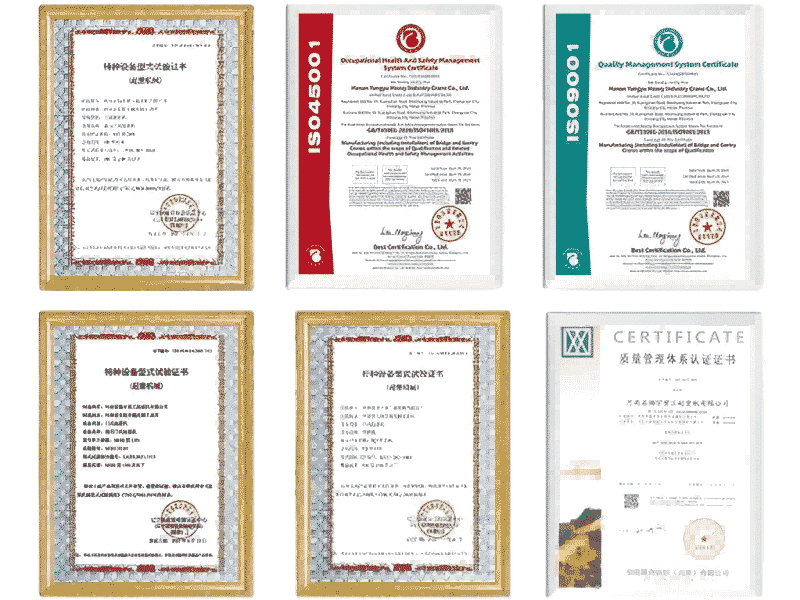
Our Crane Certifications
Our cranes (overhead crane, gantry crane, jib crane and electric hoist) are fully certified to meet international and local manufacturing standards. We hold complete qualification documents to guarantee product safety and reliable quality for global buyers. Below are our key certifications:
- ISO 9001 Quality Management System Certificate
- ISO 45001 Occupational Health & Safety Management Certificate
- Special Equipment Type Test Certificate for Lifting Machinery
- Manufacturing License for Lifting Equipment
- Third‑party Independent Audit Certificates
- Complete Export‑Oriented Qualification Documents
Our Custom Visit
We welcome worldwide customers to visit our manufacturing workshop. You can check crane production processes, raw materials and finished products face‑to‑face with our engineering team.
- Customized Crane Solution Design
- Professional Technical Consultation & Quotation Support
- Production Tracking & Quality Supervision
- Overseas Shipping & Complete Document Service
- After‑sales Technical Support & Guidance

FAQs About Choosing the Right Gantry Crane and Supplier
In order to obtain accurate quotes for custom overhead cranes, providing the following core information will greatly improve efficiency:
1. Key specifications: including rated lifting weight (tons), span (i.e., track spacing, meters), and lifting height (meters), which is the basis of the design.
2. Use environment and working conditions: Explain the conditions of the installation site (such as indoor/outdoor, temperature, humidity) and work level (busy level), which determines the material selection and configuration level of the structure.
3. Specific configuration requirements: clarify the drive mode (such as frequency conversion control), brand preferences for electrical components, safety devices (such as overload limiters, anti-collision systems), and whether special functions such as remote control are required.
4. Installation and service: confirm the on-site power supply conditions (voltage, frequency), installation conditions, and specific expectations for delivery time, installation and commissioning, and after-sales service.
The more detailed the information provided, the more accurate and reliable the solutions and quotations obtained.
1. Span and lifting capacity: this is the foundation.The larger the span and the higher the rated lifting weight, the material and design costs of the main beam and structure will increase significantly, and the higher the price.
2. Working level and frequency of use: The working level (A1-A8) represents the busy level and load status of the crane.Cranes with frequent and heavy-duty use require more durable motors, gearboxes and structural parts, and the cost is naturally higher than that of lightweight and occasionally used equipment.
3. Structure and configuration: The double beam is more complex and stable than the single beam structure, and the price is higher.At the same time, the lifting height, operating speed, motor brand, control system (ordinary vs frequency conversion), and the level of safety devices (such as anti-swing, load monitoring) all directly affect the final quotation.
4. Degree of customization and brand service: completely standard models have lower costs.The customized design based on the workshop environment (such as explosion-proof and high temperature), special processes (such as metallurgical special), brand added value, and after-sales guarantee system will all be reflected in the price.
In simple terms, when buying a bridge crane, it is necessary to consider “how much, how frequently, what environment and what configuration”, which determine its core value and price.
Which crane to choose mainly depends on your specific needs. You can quickly judge from the following four core aspects:
-Single-beam bridge crane: it is suitable for conventional workshops with light and medium loads (usually ≤20 tons), medium span, and low frequency of use. It is the most economical and versatile choice.
-Double-girder bridge crane: used for heavy-duty, long-span, or high-work-level occasions (such as frequent hoisting, metallurgy, heavy-duty assembly). Its stability, durability, and safety are higher, but the cost is also increased accordingly.
-Free vertical crane (cantilever/column type): suitable for fixed working points and working conditions with limited rotation range, such as beside machine tools, maintenance areas, or production line stations, it can efficiently use corner space and be installed flexibly.
-Grab crane: It is specially used for the handling, loading, and unloading of bulk materials (such as grain, coal, sand, and gravel). The only reason to choose it is that you need to deal with such unpackaged loose materials.
In simple terms, you can filter according to this logic:
First, according to the lifting weight and span, choose between a single beam and a double beam.
If the scope of operation is highly concentrated and the space is limited, consider a free vertical.
If the handling object is bulk material, it points directly to the grab type.
Yes. Our bridge cranes fully comply with and follow relevant international standards. Our company has passed a number of international certifications, such as the ISO 9001 quality management system, which guarantees that the management system ensures every aspect of the product, from design to delivery, is under high standards of quality control. Therefore, you can rest assured that our cranes are internationally competitive in terms of safety and quality.
In order to ensure the versatility, safety, and reliability of our products on a global scale, we strictly follow the mainstream international standard systems, including the International Electrotechnical Commission (IEC), European (EN/DIN), and the United States (ANSI/ASME) in the design and manufacturing process. For example, for the EU market, our products meet the detailed requirements of the Machinery Directive and CE certification. At the same time, we also actively adapt to specific regulations in other regions to meet the compliance needs of different customers.
Delivery times largely depend on whether the crane is standard or customized. Based on our experience, standard single-girder and double-girder cranes can be produced more quickly, while cranes with special spans, duty ratings, or environmental requirements naturally require additional engineering design time.
For each quotation, we provide an estimated production and delivery schedule based on your configuration and destination. Throughout the manufacturing process, our team maintains communication with the customer to ensure no unexpected issues arise before shipment.
Compared with many suppliers, Yangyumech mainly reflects the two differentiated advantages of high customization flexibility and clear international compliance when providing bridge cranes.
On the one hand, we focus on in-depth customized services. According to your specific needs, we can provide fully customized solutions on core parameters such as rated load capacity, span, and lifting height, and accept personalized requirements. This means that what you get is not a standard product, but exclusive equipment that accurately matches the working conditions of your workshop.
On the other hand, we attach importance to international standards and quality certification. Our products clearly meet the requirements of international certifications such as CE, which ensures that their safety and reliability can meet the mainstream standards of the international market, and provides you with additional quality confidence guarantees. Combined with our direct supply capabilities as a powerful factory, we can achieve better comprehensive value for you while obtaining compliant and customized products.
Hot Products
Single Girder Gantry Crane
- Capacity: 0.3t-36t; Span length: 4-35m
- Lifting height: 6m, 9m, 12m, etc.
- Raged voltage: 220V~690V
- Lifting height: 6m, 9m, 12m, etc.
- Raged voltage: 220V~690V
LD Single Beam Bridge Crane
- Single welding box girder
- Lifting Height: 5-50m
- Capacity: 1t-40t
- Lifting Height: 5-50m
- Capacity: 1t-40t
European Standard Electric Hoist
- Capacity: 1t-12.5t
- Working Class(FEM): 1Am-4m
- Lifting Height (m): 6/9 12/18
- Working Class(FEM): 1Am-4m
- Lifting Height (m): 6/9 12/18
Get In Touch
Yangyumech is a leading professional manufacturer of cranes in China. Our company integrates the processes of crane research and development, manufacturing, sales and service.