
A gantry crane is not simply a bridge crane on legs. The European gantry crane also called a European portal crane — runs on floor-mounted rails rather than building-supported runways, and that single difference reshapes everything about engineering, installation, and daily use. Whether equipping an outdoor stockyard, a prefabrication workshop, or a rail-mounted container terminal, understanding the components and the single versus double girder choice is where a sound procurement decision starts.
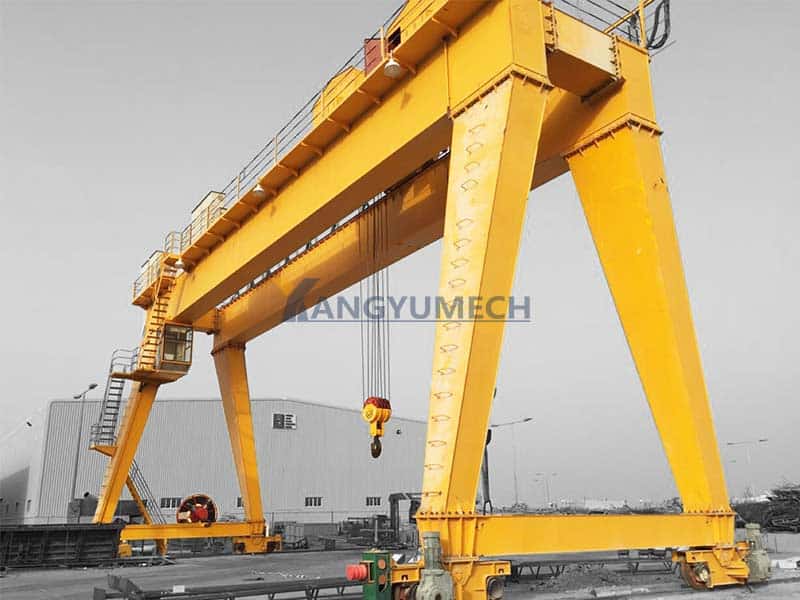
Main Components of a European Gantry Crane
The european gantry crane components follow a modular logic. Each element is designed for structural function and shipping logistics — European gantry cranes are routinely shipped as bolted assemblies, which matters when the container is crossing an ocean.
The gantry girder is the horizontal bridge beam that carries the hoist and trolley. European gantry crane girders are box-section fabrications designed to FEM standards, using high-strength steel to reduce self-weight. The european gantry crane design philosophy keeps the girder as light as the load calculations allow — less steel means smaller drive motors and lighter legs, which cascades through the entire cost structure.
The gantry legs connect the girder to the end carriages at floor level. European gantry crane legs are typically A-frame or box-section structures bolted to the girder, with one leg pair rigid and the other articulated slightly for rail irregularities. On single girder units, the legs are shorter and attach directly beneath the beam; on double girder configurations, the leg height is greater because the trolley rides above the girders.
European gantry crane end carriages sit at the base of each leg pair, housing VFD-driven bridge drive motors with hardened steel wheels matched to the wheel load. Two-wheel drive is standard; four-wheel drive is specified for long spans or outdoor wind conditions.
The hoist unit is the same european electric wire rope hoist used on bridge cranes — FEM-rated drum and gearbox inside a trolley frame. The gantry difference is that the hoist must contend with outdoor conditions: dust, rain, wind, and temperature swings. This is why european gantry crane specifications often mandate IP55-rated motors and enclosed control cabinets as standard.
European Single Girder vs. Double Girder Gantry Crane: What Actually Differs
The european gantry crane single vs double girder question often gets reduced to capacity, but that oversimplifies the engineering.
A european single girder gantry crane carries the hoist trolley on the bottom flange of one main beam. The legs attach directly under the girder, keeping the overall structure compact. Typical european gantry crane capacity for single girder designs spans from 1 to 20 tons, with lifting heights from 6 to 12 meters and spans up to 35 meters between the legs. These cranes dominate general workshop bays, light fabrication halls, and indoor material storage because they are cost-effective and straightforward to install on existing floor rails.
A european double girder gantry crane places the trolley on rails welded to the top of two parallel bridge beams, with taller legs supporting the assembly. This configuration achieves two things a single girder cannot. It delivers higher hook height at a given clearance — because the hoist sits between the girders rather than below them — and it handles heavy loads from 20 to 500 tons with working duty classifications from M5 to M8. Steel plate handling, precast concrete, and shipyard block assembly all favor double girder for structural headroom and fatigue performance under continuous duty.
The double girder configuration also allows cantilever extensions beyond the leg — common in outdoor yards — so a european double girder gantry crane can load trucks without the trolley entering the main bay. Single girder supports light cantilevers, but the structural economics favor double girder for meaningful outreach.
The trade-off runs deeper than purchase price. A double girder european gantry crane price reflects more steel, larger legs, heavier rail sections, and a longer installation cycle — justified only when the application genuinely needs the extra hook height, extended span, or heavy duty cycle. Below 20 tons with moderate use, a single girder system is almost always the better value.
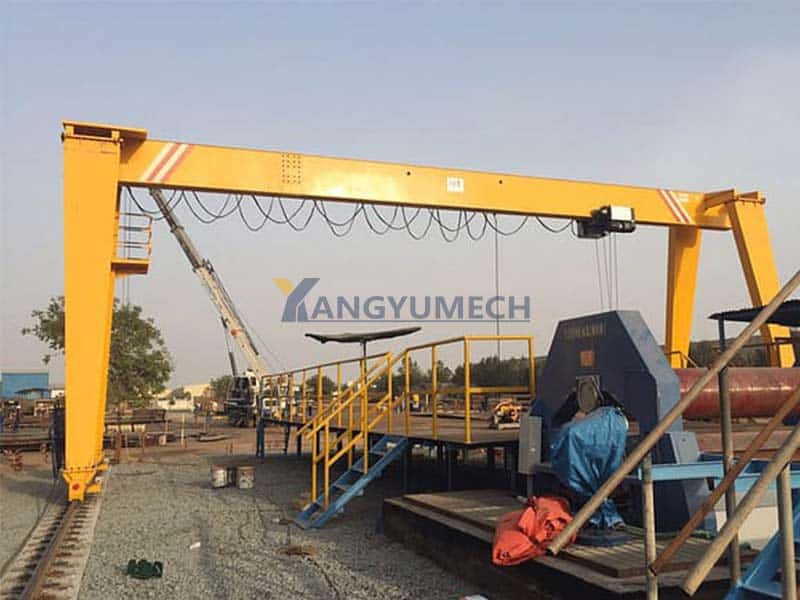
What to Trust in a Specification
Beyond the girder decision, the european gantry crane duty classification is central: FEM 1Am to 3m for standard workshop use, M5 to M8 for steel handling, shipyard, and continuous lifting. Hoist and bridge travel speeds should be reviewed against actual cycle rate, not just the catalog number. For any outdoor installation, verify wind load rating — sustained winds above 20 m/s require upsized drives and rail clamping.
Why Yangyumech
Yangyumech is a professional european gantry crane manufacturer producing single girder and double girder portal crane systems for industrial, logistics, and heavy-manufacturing environments worldwide.
Every Yangyumech european gantry crane is fabricated to FEM standards from high-grade structural steel, assembled per bolted-module design for containerized shipping, and load-tested at the factory. Documentation packages ship with each crane, including inspection certificates, as-built wiring diagrams, and full operation manuals.
The engineering team works with procurement managers, plant engineers, and logistics coordinators to configure the right european gantry crane specifications — girder type, span, lift height, duty class, cantilever length, and control options. As a european gantry crane manufacturer China-based, Yangyumech offers competitive european gantry crane pricing backed by transparent configuration support and organized export logistics to ports across Europe, Southeast Asia, the Middle East, and the Americas.