
Walk through a steel structure plant and the crane is never idle. It lifts raw plates onto the cutting table, carries a welded beam across the bay, flips a finished truss for paint, and finally sets a loaded trailer on its way to the jobsite. The machine tying all of that together is a heavy-lift gantry crane, and in most plants it has to be built to order.
What the Crane Does Across the Production Flow
Infeed and Cutting
Steel arrives as plates and sections. A gantry crane for steel structure work lifts bundles off delivery trucks and onto the cut-and-drill line. At this stage speed matters less than a smooth, stable hook—dropping a plate stack is expensive, so controlled travel beats raw pace.
Fit-Up and Welding
This is where the crane earns its keep. Long H-beams and box girders have to be held level, nudged into alignment, and sometimes rotated for full-penetration welds. A heavy lift gantry crane with slow, inching speed and a lifting beam lets the fitter place a member to the millimeter without fighting the machine.
Assembly, Paint, and Load-Out
Finished assemblies get flipped for inspection and paint, then carried to the load-out bay. If the crane has to reach outside to a stock yard or a trailer lane, it also has to be rated for wind and weather—something an indoor-only unit is not.
What to Lock Down Before Ordering
The Heaviest and Longest Piece, Not the Average
Spec the worst member the plant will ever move. A gantry crane for steel structure factory that’s sized for today’s typical beam becomes a bottleneck the first time a 40-meter truss shows up. Add rigging weight, then add margin.
Span, Hook Height, and Travel Path
Measure the widest bay and the tallest stack, then trace the crane’s full travel from the cutting line to the load-out door. Getting the span or the height wrong means a machine that can’t actually reach the work, and that’s an expensive lesson.
One-Point or Two-Point Lifting
Long members sag and swing on a single hook. Decide early whether you’ll lift at two points with a double trolley or a spreader beam. It changes the girder design, so it belongs in the first drawing, not the last.
Duty Class and Power
A plant running two shifts of near-continuous lifts needs a heavier structure and bigger drives than a shop that lifts occasionally. State the duty class honestly and confirm your supply voltage up front.
Crane Models and Their Structural Features
Box-Type Double Girder with Twin Trolleys
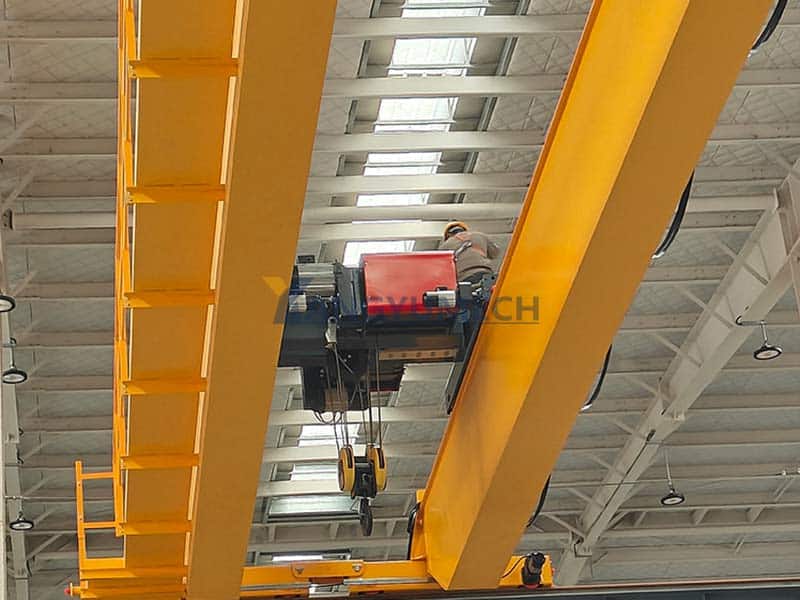
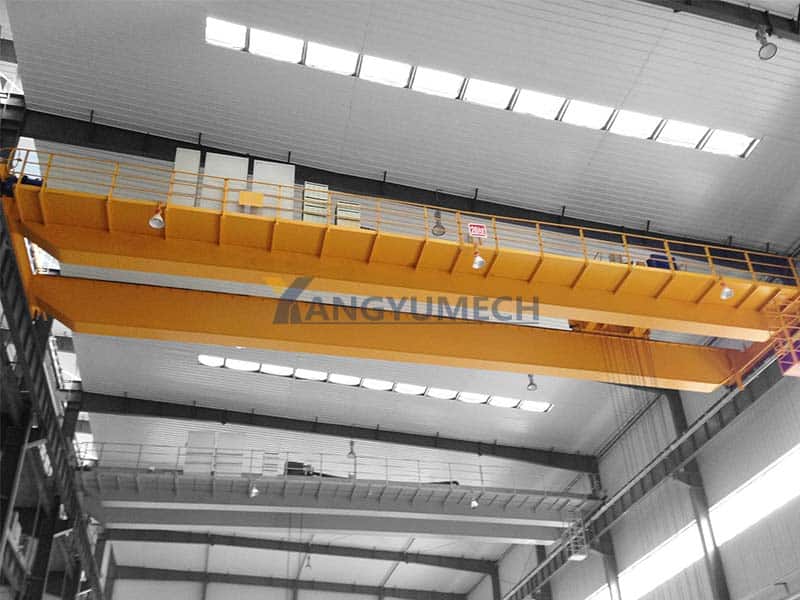
The default for big steel plants. A double girder gantry crane with a box section gives the stiffness to carry 50 tons and up without flexing, while two trolleys keep a long H-beam level during lift and travel. This is the heavy lift gantry crane most large fabrication shops run in their main bay.
A-Frame Single Girder
For lighter members and tighter budgets. A single girder gantry crane with A-frame legs costs less and weighs less, so it sits well in a secondary bay handling parts and sub-assemblies up to around 20 tons.
Semi-Gantry for Tight Halls
When floor columns are precious, a semi gantry crane runs one leg on a ground rail and the other on a runway fixed to the building wall. It frees a whole row of space, but the wall connection has to be engineered properly or you’ll inherit a structural headache.
Lattice Girder for Long Outdoor Spans
An open stock yard with a very long span favors a lattice gantry crane. The truss-style girder weighs less than an equivalent box, which cuts wheel loads and foundation cost, at the price of extra fabrication labor.
Rotating Spreader and Custom Attachments
A gantry crane for workshop use becomes a steel-handling tool the moment you add a powered rotator or a custom lifting beam. These attachments turn a generic crane into one that can flip and position columns and trusses the way the assembly line actually needs.
Mistakes That Cost Real Money Later
The most common regret is undersizing capacity to save on the quote, then paying for it every shift for twenty years. A close second is buying a cheap indoor crane for a job that runs outdoors, then fighting rust and wind before the first maintenance cycle. Foundation and rail alignment get overlooked too—a gantry crane is only as straight as the track under it. And retrofit attachments cost far more than specifying a double trolley or spreader beam from the start. Yangyumech avoids these by designing the attachment into the crane, not around it.
Why Buy Your Heavy-Lift Gantry Crane from Yangyumech
Yangyumech is a gantry crane manufacturer that builds custom heavy-lift gantry cranes for steel structure factories, from single girder units to double girder, semi-gantry, and lattice models rated up to 500 tons. Every crane is engineered around your member weight, length, span, and duty cycle—each one a custom gantry crane—with the lifting beam or twin trolley designed in from the first drawing.
The service runs end to end. Yangyumech engineers review your production flow and layout, recommend the right model and girder structure, and supply matched lifting beams, rotators, and controls. Each crane ships with CE and ISO documentation and a documented load test, backed by installation support and after-sales service. Because we build the structure, hoist, and controls in-house as one package, you deal with one accountable partner and pay factory cost, not a stack of distributor margins.