
If you run a container yard or a heavylift operation, you’ve almost certainly seen both types of gantry crane on a site visit somewhere. They look similar from a distance—both straddle their load on a beam held up by legs. Up close, though, the way they move tells you everything about which one belongs in your yard.
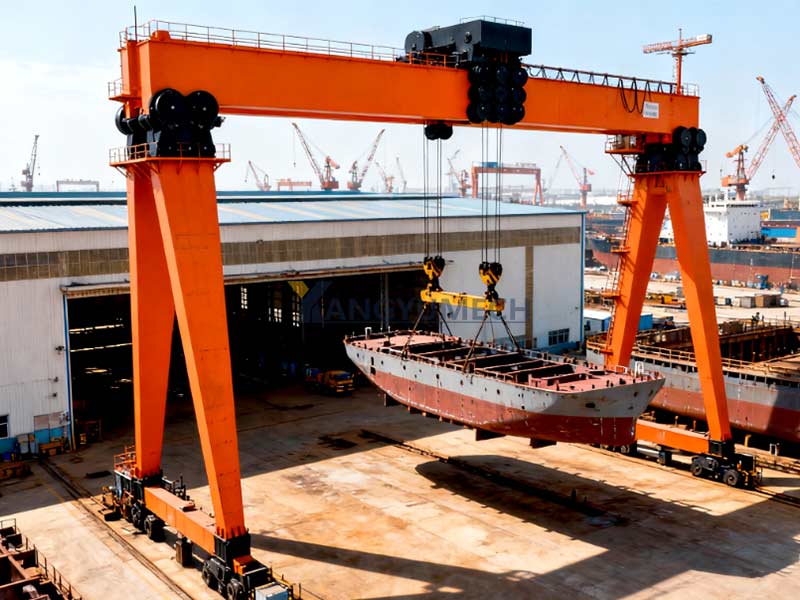
RMG vs RTG Gantry Cranes: The Core Difference
The shorthand most engineers use is straightforward. RMG stands for rail mounted gantry crane. RTG stands for rubber tyred gantry crane. One runs on steel rails set into the ground. The other rolls on rubber tires, much like a giant forklift with a roof beam.
How They Move
A rail mounted gantry crane travels along fixed tracks, so its path never changes. That sounds like a restriction, but for repetitive work it’s a real strength—the crane repeats the same cycle thousands of times with no drift. A rubber tyred gantry crane, by contrast, can drive anywhere in the yard its tires can reach. You can shift it to a different row of containers in minutes, which gives you flexibility a rail system simply can’t match.
Where Each One Works Best
RTG cranes dominate in container terminals where stacks get moved around and rows are reorganized. They’re also the common pick for general yards and project cargo. RMG cranes suit high-volume, fixed-lane operations—think rail terminals, dedicated container blocks, and intermodal hubs where the layout is set in stone. Because the rail system is powered and guided, RMG units tend to handle heavier, steadier cycles.
Cost, Power, and Site Prep
Here the trade-offs get practical. An RTG needs no track, but it needs a prepared, level surface and either diesel power or a cable reel for electric drive. An RMG needs a foundation and rails poured into the ground, a bigger upfront build—but once it’s in, it’s cheaper to power and maintain. If your yard layout is permanent, RMG usually wins on lifetime cost. If you expect to rearrange the site, RTG keeps your options open.
Can I Customize a Gantry Crane?
Short answer: yes, and you should. A gantry crane is rarely a catalogue purchase. The better suppliers build to your site, not the other way around.
Capacity, Span, and Lift Height
These three numbers shape the whole machine. Tell your supplier your heaviest load, the distance between the legs (that’s the span), and how high the hook must reach. A small workshop unit might be a 5 ton gantry crane on a short span, while a port block needs 40 ton capacity and a tall lift. Get these wrong and nothing else matters.
Girder Type and Hoist Options
Most gantry cranes are built as a single girder gantry crane for lighter duty or a double girder gantry crane when you need headroom and endurance. The hoist is just as important—pair the crane with an electric hoist sized for your cycle, or step up to a smoother, energy-efficient hoist for indoor work.
Controls and Site Conditions
Customization also covers the details: cabin versus radio control, speed profiles, anti-sway systems, and weather protection for outdoor duty. Wind zone, duty class, and power supply all feed the design. A crane built for a calm indoor hall is a different animal from one that works a windy quayside.
Where a Bridge Crane Fits the Picture
Sometimes the right answer isn’t a gantry at all. If your lifting happens inside a building with runway beams already installed, an overhead bridge crane for workshop use is often the smarter move. A single girder bridge crane keeps costs down for lighter loads, while a double girder overhead crane handles the heavy, precise work. For buyers sourcing abroad, a bridge crane manufacturer like Yangyumech that meets CE and ISO standards protects both your budget and your compliance. The point is to match the machine to the building and the job—not to force a gantry where a bridge crane belongs.
Custom Crane Solutions from Yangyumech
Yangyumech builds lifting equipment to order, and gantry cranes are a core part of that work. We design and manufacture rail mounted gantry cranes, rubber tyred gantry cranes, single girder gantry cranes, and double girder gantry cranes rated up to 500 tons. Alongside them we supply single girder bridge cranes, double girder overhead cranes, electric hoists, chain hoists, KBK systems, jib cranes, and scissor lift platforms to cover a complete handling line.
Every Yangyumech project starts with your layout. Our engineers confirm capacity, span, and lift height, then recommend the girder type, hoist, and controls that fit your duty cycle. Whether you need a custom bridge crane for a new hall or a tailored RTG for a growing container yard, we deliver with full documentation, installation support, and dependable after-sales service.