
In modern industrial facilities, efficient material handling determines the productivity, safety, and operational efficiency of the entire plant. When lifting capacity requirements remain 20 tons or below, the single girder overhead crane emerges as the most versatile and economical solution. With its simplified structure, modular components, and adaptable configurations, this crane system is capable of fitting into a wide variety of building constraints—from aging factories with low headroom to newly built workshops requiring precision lifting.
Understanding the Structure of a Single Girder Overhead Crane
A single girder overhead crane consists of a streamlined structural configuration designed to deliver maximum lifting efficiency with minimal installation complexity. The core components include:
Main Girder – The primary load-bearing beam supporting the hoist and trolley.
End Carriages (End Beams) – Wheels and frame assemblies enabling bridge travel along runway rails.
Electric Hoist – Lifting mechanism responsible for vertical movement.
Trolley System – Horizontal movement of the hoist along the girder.
Electrical Control System – Controls motion, safety features, and automation.
Runway Rails and Support Structure – Allow the bridge to travel across the facility.
The Main Types of Yangyumech Single Beam Bridge Cranes
Different plant layouts and operational requirements demand different crane configurations. The following designs represent the most commonly deployed single girder overhead crane systems.
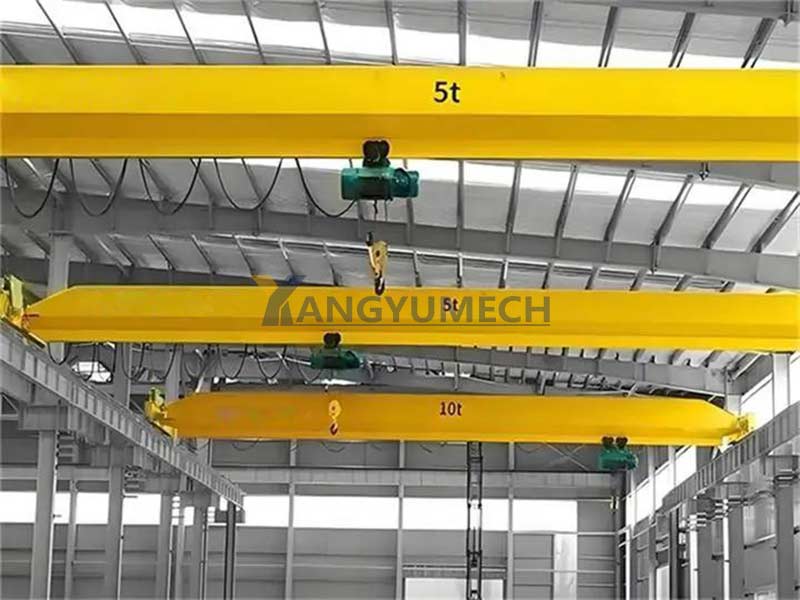
1. Single Girder Electric Overhead Travelling Crane (EOT Crane)
The single girder electric overhead travelling crane remains the most widely installed crane in industrial workshops, warehouses, and maintenance facilities.
Its popularity stems from an ideal combination of cost efficiency, operational flexibility, and structural simplicity.
Key Specifications
Parameter-Value
Lifting Capacity: 0.5–20 tons
Span: 7.5–31.5 m
Lifting Height: 6–30 m
Work Duty: A3–A4
Voltage: 220V–660V, 50–60Hz, 3-phase
Control Method: Pendant / Remote / Cabin
Traveling Speed: 20–30 m/min
Typical Applications
– Machinery manufacturing workshops
– Equipment assembly lines
– Maintenance workshops
– Warehousing operations
– Fabrication plants
Structural Characteristics
The hoist trolley runs on the lower flange of the main girder I-beam, providing stable lifting performance while maintaining a compact design.
2. Low Headroom Single Girder Overhead Crane
When factory buildings suffer from limited vertical clearance, conventional cranes cannot provide sufficient lifting height. The low headroom overhead crane addresses this challenge by minimizing the distance between the hook and the girder.
Design Advantage
The hoist adopts a compact side-mounted structure, enabling the hook to travel closer to the girder.
Ideal Situations
– Old factory buildings with limited headroom
– Workshops with low roof elevations
– Plants requiring maximum lifting height within restricted vertical space
Technical Parameters
Parameter – Specification
Capacity: 1–20 tons
Span: 7.5–31.5 m
Lifting Height: Up to 30 m
Work Duty: A3–A4
Control: Pendant / Remote
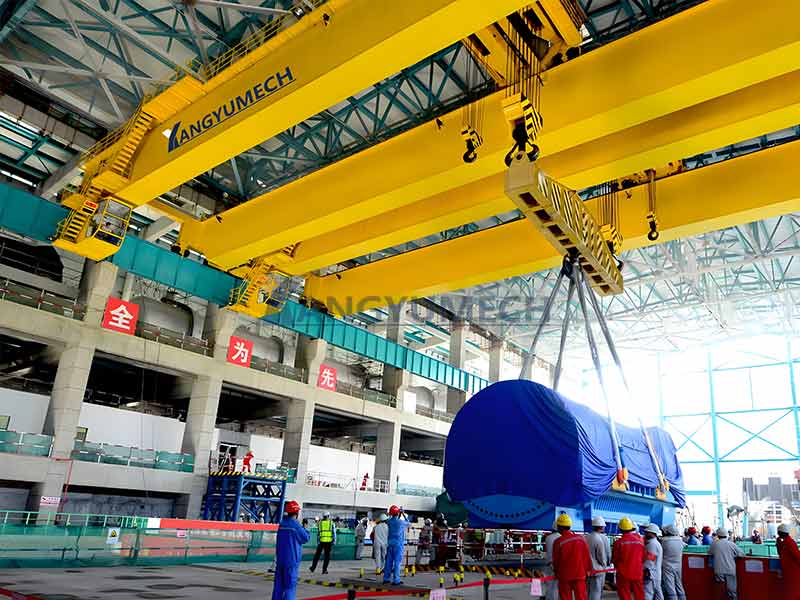
3. Underslung Single Girder Overhead Crane
The underslung (under-running) overhead crane is designed for facilities where runway beams are suspended from the building roof structure rather than supported by floor columns.
Key Characteristics
– Runway beams suspended from roof trusses
– Excellent side approach capability
– Reduced building structure requirements
– Compact layout for smaller facilities
Typical Applications
– Buildings without supporting columns
– Lightweight manufacturing plants
– Assembly workshops
– Maintenance facilities
Technical Parameters
Parameter – Value
Capacity: 0.5–10 tons (standard)
Span: 3–16 m
Lifting Height: 6–30 m
Work Duty: A3–A4
Voltage: 220–660V
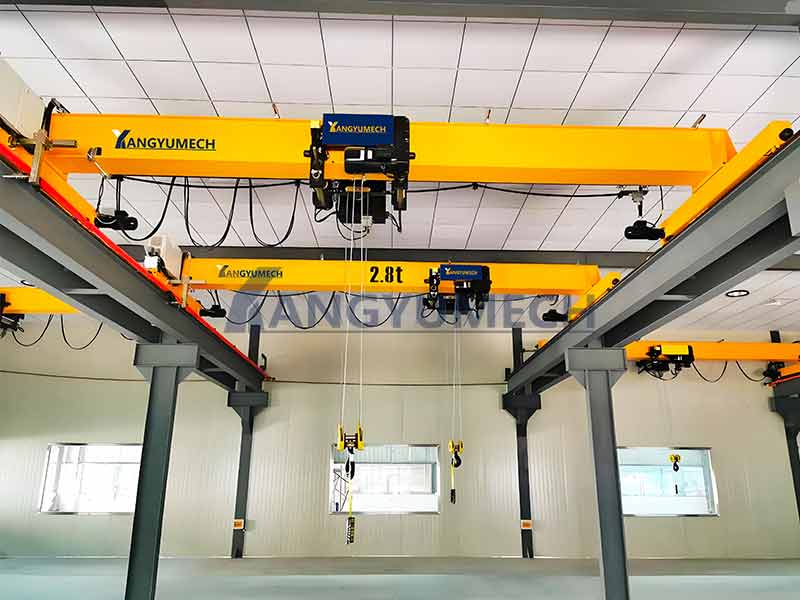
4. FEM/DIN European Standard Single Girder Overhead Crane
The European FEM/DIN standard single girder crane represents a highly optimized modern design engineered for precision handling and reduced maintenance.
Engineering Features
– Three-in-one drive unit (gearbox + motor + brake)
– Compact structural layout
– Variable frequency speed control
– Low noise operation
– Lifetime maintenance-free brake pads
Performance Advantages
– Smaller hook approach limits
– Improved workspace coverage
– Higher work duty rating (A5)
– Precision load positioning
Technical Specifications
Parameter – Value
Capacity: 1–20 tons
Span: 7.5–28.5 m
Lifting Height: 6–18 m or customized
Work Duty: A5
Control: Pendant / Remote
Typical Industries
– Automotive manufacturing
– Petrochemical processing
– Port logistics facilities
– Aerospace workshops
– Precision equipment assembly
5. Offset Trolley Single Girder Overhead Crane
The offset trolley crane introduces an angled trolley arrangement that significantly improves vertical space utilization.
Structural Innovation
Instead of positioning the hoist directly beneath the girder, the trolley is offset to allow the hook to lift higher.
Ideal Scenarios
– Workshops with low crane runway height
– Facilities requiring greater hook lifting height
– Plants where structural modification is impractical
Key Specifications
Parameter – Specification
Capacity: 1–20 tons
Span: 7.5–28.5 m
Lifting Height: Up to 30 m
Work Duty: A3–A4
Control: Floor / Remote
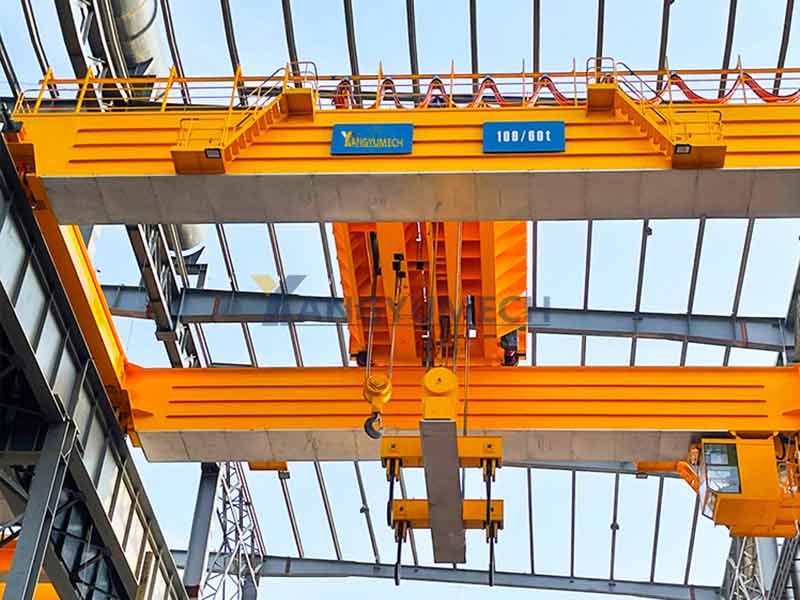
6. Manual Single Girder Overhead Crane
In environments where electric power cannot be supplied, manual cranes provide a reliable alternative.
Operating Mechanism
Movement and lifting are driven by manual chain blocks and gear mechanisms.
Advantages
– No electrical requirements
– Lower installation cost
– Ideal for hazardous environments where electrical equipment is restricted
Typical Applications
– Chemical facilities
– Explosion-proof environments
– Small workshops
– Remote industrial locations
Advantages of Single Girder Overhead Cranes
Single girder overhead cranes remain the preferred solution for medium-duty industrial lifting because they provide:
– Lower manufacturing cost
– Faster installation
– Reduced structural load on buildings
– Simplified maintenance
– High operational flexibility
– Easy transportation and dismantling
Their adaptable structure allows integration into both new facilities and older industrial buildings with minimal modification.
Conclusion
Single girder overhead cranes deliver a powerful combination of economy, flexibility, and efficient material handling for lifting capacities up to 20 tons. By selecting the appropriate configuration—standard EOT, low headroom, underslung, European FEM/DIN, offset trolley, or manual—industrial facilities can fully utilize available space while maintaining safe and reliable lifting operations.
A properly matched crane solution transforms limited workshop space into a highly efficient production environment, maximizing lifting height, improving workflow efficiency, and ensuring long-term operational reliability.
Yangyumech specializes in the design, manufacturing, and sales of various single-girder bridge cranes. Our products cover light, medium, and heavy duty capacities and duty classes, widely used in industrial settings such as workshops, warehouses, and production lines. Yangyu cranes are characterized by compact structure, smooth operation, and flexible, reliable performance, committed to providing customers with efficient material handling solutions.